.png)

Best windows for noise reduction: Quiet, Comfortable Homes Start Here
If you're on the hunt for the best windows for noise reduction, you’ll quickly find it’s not about a single product. The quietest homes rely on a complete window system where every component works together. The magic ingredients are a specific combination of multi-pane glass of varying thicknesses, specialized interlayers (like laminated glass), wide gas-filled air gaps, and solid, perfectly sealed frames.
Your Quick Guide to a Quieter Home

Upgrading your windows is one of the most effective home exterior renovation ideas you can tackle—not just for curb appeal, but for carving out a peaceful sanctuary indoors. Think of a high-performance window not as a simple sheet of glass, but as a sophisticated sound barrier. Every part is engineered to disrupt, dampen, and absorb sound waves before they ever reach your ears.
This isn't just a niche concern anymore. As cities grow louder, so does the demand for peace and quiet. The global soundproof windows market hit a value of approximately USD 4.8 billion in 2023 and is on track to nearly double, reaching a projected USD 8.5 billion by 2032. Homeowners are clearly prioritizing quieter living spaces.
Key Features at a Glance
To make your search easier, let’s break down the essential components that make a window truly effective at blocking noise. Understanding how these features team up is the first step toward making a smart investment for your home.
A window's ability to block noise is only as strong as its weakest link. Superior glass is ineffective if the frame is poorly insulated or the installation leaves gaps for sound to penetrate.
To help you compare different window options, we've put together a table summarizing the most important features and what they actually do.
Key Features of Noise-Reducing Windows at a Glance
This table breaks down the most important window components and how they contribute to effective soundproofing. Use it as a quick reference to see what really matters when you're looking at different products.
| Glass Type | High impact; laminated glass is the gold standard. | Laminated or acoustic glass with a PVB interlayer. |
| Glass Thickness | Significant; varied thicknesses disrupt more frequencies. | Asymmetrical glazing (e.g., one 1/4" pane, one 1/8" pane). |
| Number of Panes | Moderate; triple-pane is better, but construction matters. | Double-pane with acoustic upgrades or triple-pane. |
| Gas Fill & Spacing | Good; wider, gas-filled gaps improve sound insulation. | Argon or Krypton gas fill with at least a 1/2" air gap. |
| Frame Material | Important; solid, insulated frames prevent vibrations. | Foam-filled vinyl, fiberglass, or solid wood frames. |
| Professional Sealing | Critical; airtight installation prevents sound leaks. | High-quality weatherstripping and professional caulking. |
Each of these elements plays a crucial role. When you find a window that combines several of these high-performance features, you're on the right track to a much quieter home.
Understanding How Sound Enters Your Home
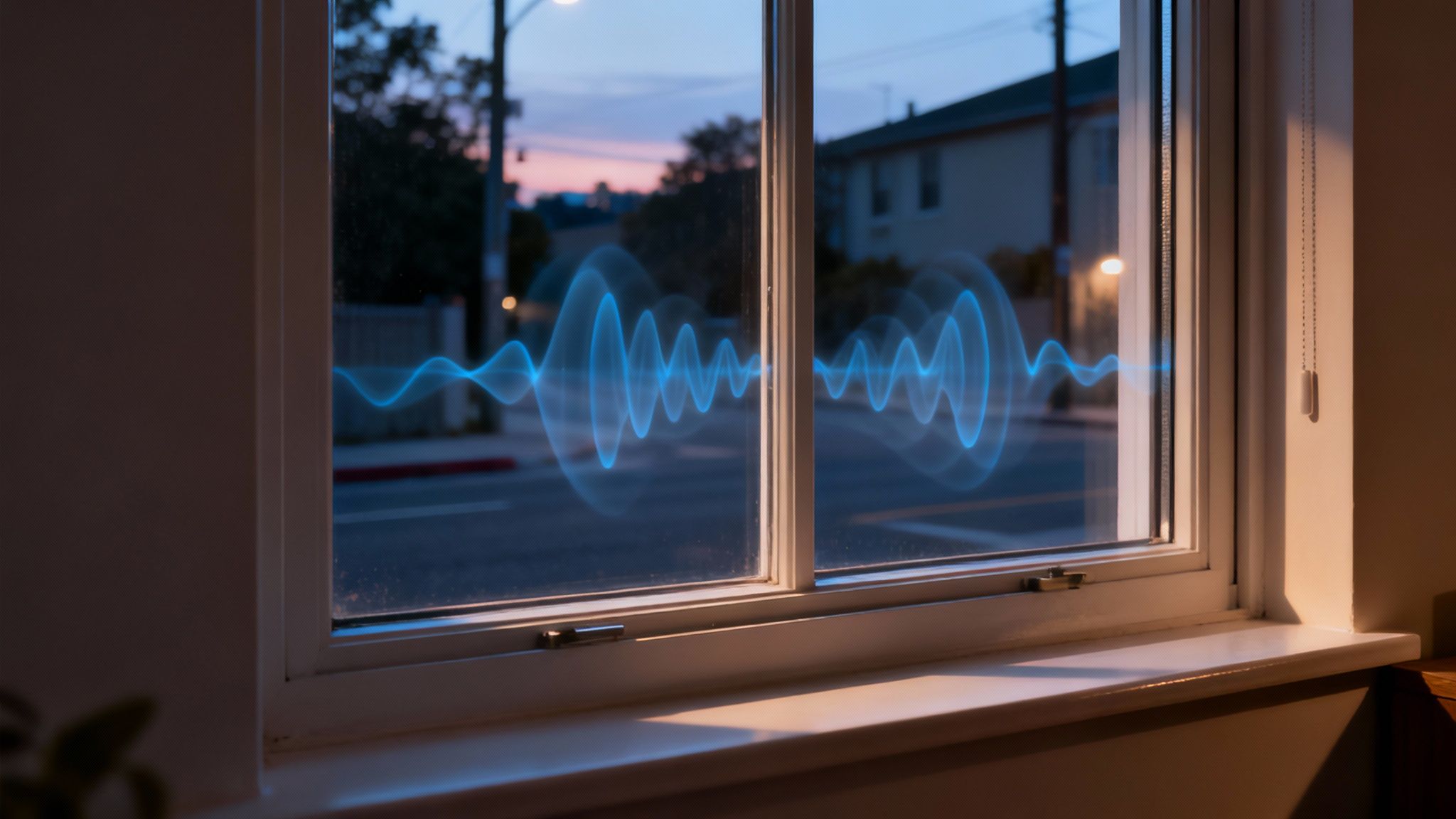
Before you can choose the right windows to quiet your home, you have to understand how noise gets inside in the first place. It helps to think of sound not as a random annoyance, but as energy traveling in waves. Just like water, these waves will find any weakness—a tiny crack, a small gap, or a thin barrier—to flow from the noisy world outside into your living space.
Your windows are almost always the biggest vulnerability. A solid, insulated wall can block a ton of noise, but a standard single-pane window is like an open door for sound. The vibrations from traffic, barking dogs, or a neighbor's lawnmower hit the glass, causing it to vibrate and pass that sound energy right into your room.
Sound Waves and Frequencies
Not all noises are created equal. The two main types of sound you'll deal with have completely different personalities, which is why a one-size-fits-all window solution rarely works.
- Low-Frequency Sounds: These are the deep, rumbling noises—the drone of a passing truck, the hum of an airplane, or the bass from a neighbor's stereo. Their long sound waves carry a lot of energy and are notoriously difficult to stop with just a simple barrier.
- High-Frequency Sounds: These are the sharper, more distinct noises like birds chirping, kids shouting, or the screech of tires. Their short, choppy waves are generally easier to deflect and absorb, but they can still be incredibly distracting.
A truly effective noise-reducing window has to be engineered to fight both types of sound waves. This is why simply adding another pane of glass isn't always the full answer; the entire window system has to work together to disrupt a wide range of frequencies.
The Two Paths of Sound Transmission
Sound has two favorite ways to sneak into your home, and your windows are an easy target for both. To get real peace and quiet, you have to block both paths.
1. Direct Transmission Through Materials This happens when sound waves physically hit a surface, like your window glass, and make it vibrate. That vibration travels straight through the material and comes out the other side as sound. A thin, single pane of glass vibrates easily, making it a terrible sound barrier.
2. Airborne Transmission Through Gaps This is the more obvious culprit. Any crack or opening, no matter how small, creates a direct highway for sound to travel through the air and into your home. This is a huge problem with older, poorly sealed windows.
Sound is relentless—it will always find the path of least resistance. Even the most advanced acoustic glass is useless if the window frame has air leaks. A complete, airtight seal is non-negotiable for effective noise reduction.
Of course, sound can find other ways in besides your windows. To truly soundproof your space, you'll want to find and seal air leaks throughout your home to support your window upgrades. While windows are the main focus here, a well-sealed home is a key part of the big picture. For more on protecting your home from the elements, check out our guide to protecting your South Carolina home.
Decoding Soundproof Window Ratings
When you start looking at windows built for noise reduction, you'll see a lot of acronyms on the labels. It can feel like alphabet soup, but these ratings are the only way to know if a window is truly engineered for quiet or just looks the part. Without them, you're flying blind.
The two most important ratings you'll encounter are Sound Transmission Class (STC) and Outdoor/Indoor Transmission Class (OITC). They might sound similar, but they measure completely different types of noise. Picking the right one for your home depends entirely on what you're trying to block out.
STC: The Indoor Noise Blocker
Think of the STC rating as the specialist for sounds that originate inside a building. It's fantastic at measuring how well a material blocks mid-to-high frequency noises—the kind we humans create.
- What it measures: Voices, televisions, office chatter, and barking dogs.
- When it's important: This is a crucial number for interior walls, doors, and office partitions. It's far less relevant for blocking noise coming from outside your home.
A standard, old-school single-pane window usually has an STC rating around 26-28. A high-performance acoustic window, on the other hand, can hit an STC of 45 or higher. That's a massive difference. In fact, just a 10-point increase in STC can make the noise seem about half as loud.
OITC: The Outdoor Noise Shield
If you're battling noise from the outside world, the OITC rating is the number that really matters. It was developed specifically to measure how well a building product—like a window—blocks the deep, low-frequency sounds that travel long distances and drive homeowners crazy.
- What it measures: The rumbling sounds of highway traffic, trains, low-flying airplanes, and construction equipment.
- When it's important: This is the most critical rating for any residential window meant to give you peace and quiet from the outside world.
Low-frequency noise is notoriously hard to stop. Because OITC is designed to test for it, a window with a high OITC rating gives you a much more realistic idea of how it will perform against the drone of a busy street.
When you're comparing windows, always focus on the OITC rating to block traffic and other common outdoor sounds. A window can have a great STC score but still let that low-frequency rumble right through.
Translating Ratings into Real-World Quiet
So, what do all these numbers actually mean for your living room? It’s one thing to see a number on a sticker, but it’s another to know how it will feel.
Here’s a quick guide to help you translate those abstract ratings into the peace and quiet you can expect in your home.
Understanding STC and OITC Ratings
| 25-29 | Loud speech can be heard and understood fairly clearly. | Basic windows with minimal soundproofing. |
| 30-34 | Loud speech is audible but sounds muffled and indistinct. | A noticeable improvement over older, single-pane windows. |
| 35-39 | Loud speech is largely inaudible; only very loud shouting is heard faintly. | Homes near moderate traffic or neighborhood activity. |
| 40-44 | Most loud sounds are blocked. Provides significant quiet and privacy. | Houses near busy roads, airports, or train lines. |
| 45+ | Superior soundproofing. Creates a tranquil, library-like environment. | Urban apartments, homes in very loud areas, or anyone prioritizing maximum quiet. |
By looking at both the STC and OITC ratings, you can stop guessing and start choosing a window that’s truly engineered to solve your noise problems. It’s the surest way to make sure your investment delivers the quiet you’re after.
The Glass Is Where the Magic Happens
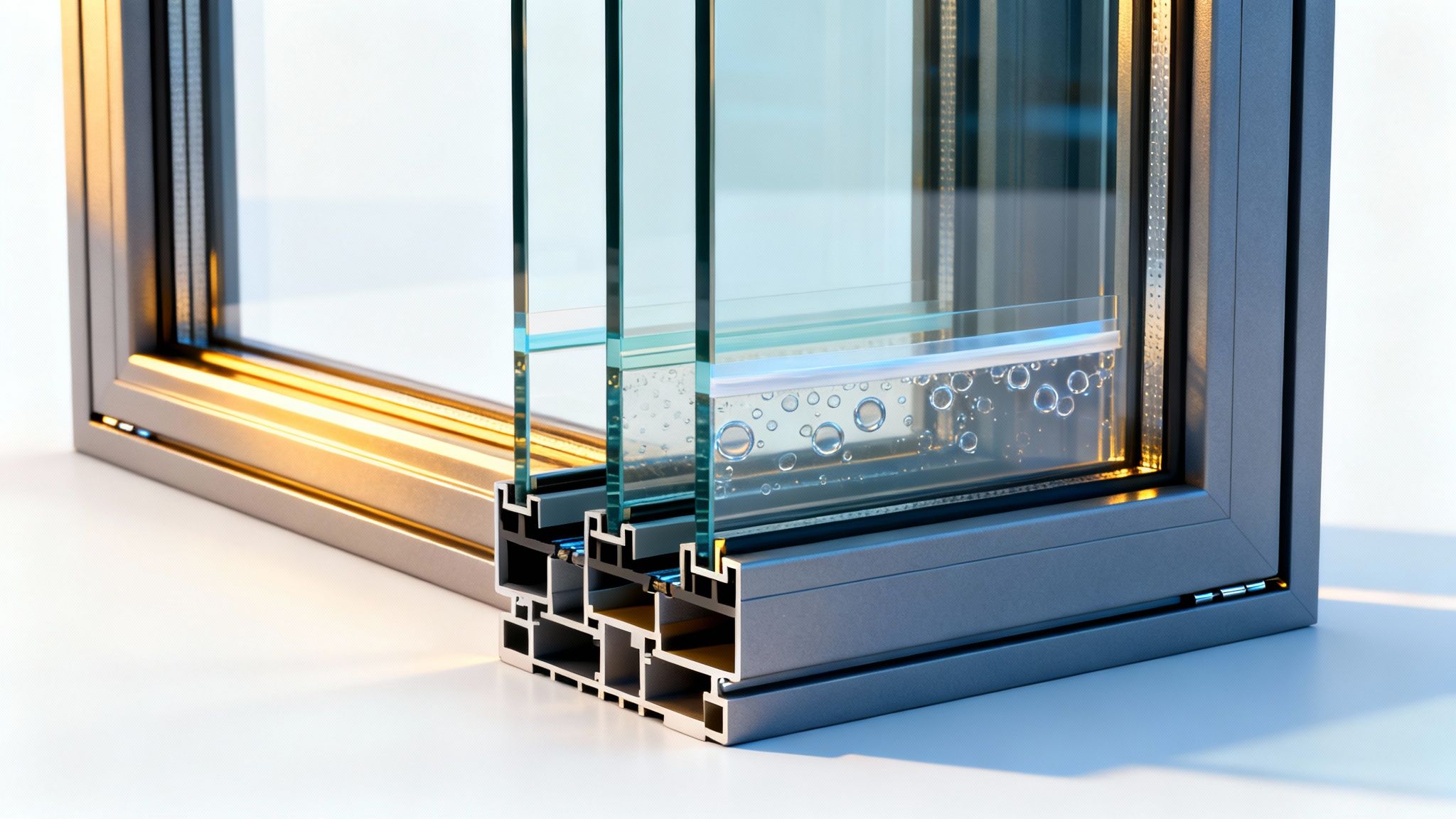
While the frame and seals are essential supporting actors, the glass is the star of the show when it comes to soundproofing. It’s the largest surface area of any window, making it the main battleground where your home’s peace and quiet is won or lost.
But here’s the secret: getting the best windows for noise reduction isn't as simple as piling on more panes of glass.
The real difference-maker is the construction of the insulated glass unit (IGU). How the panes are configured, how thick they are, and what’s between them are the details that actually stop sound in its tracks. A cleverly engineered double-pane window can run circles around a basic, off-the-shelf triple-pane unit.
Moving Beyond the Pane Count
For years, the marketing pitch was simple: three panes are better than two. And while that’s often true for keeping your home warm, it’s not the whole story for sound. Sound waves are vibrations. When they hit a window, they cause the glass to vibrate. If you have two panes of the exact same thickness, they’ll vibrate at the same frequency, passing that noise right through like a tuning fork.
This is where asymmetrical glass thickness changes the game. By using panes of different thicknesses—say, a 1/8-inch pane paired with a 1/4-inch pane—you create a much smarter barrier.
- The thinner pane is great at disrupting high-frequency sounds (like sirens).
- The thicker pane is better at breaking up low-frequency rumbles (like truck traffic).
Because each pane vibrates at a different frequency, they cancel each other out instead of working together. They effectively scramble the sound waves, weakening them before they can get inside. It's a simple trick, but the impact on audible noise is massive.
A window with mismatched glass thicknesses forces sound waves to change speed and intensity as they pass through. This scrambles the vibration, drastically cutting the amount of noise that makes it into your home. It’s a perfect example of smart design winning over brute force.
Laminated Glass: The Ultimate Sound Stopper
If asymmetrical glass is a smart tactic, then laminated glass is the heavy artillery in the war against noise. This isn’t just a solid piece of glass; it’s a high-tech sandwich. It’s made of two sheets of glass bonded together with a clear, flexible interlayer, usually made of polyvinyl butyral (PVB).
Think of that PVB layer as a tiny shock absorber for sound.
When sound waves hit the outer pane of glass, the flexible interlayer soaks up the vibrational energy and turns it into a negligible amount of heat. This process, known as vibration damping, essentially kills the sound before it can ever reach the inner pane of glass.
It’s the same technology used in your car’s windshield to reduce road noise and add a layer of safety. The latest window designs have made laminated glass a go-to for creating truly peaceful homes. In fact, research shows it can lead to noise reduction improvements of up to 50% compared to standard glass. You can find more details on how sound-dampening windows work at EcolineWindows.ca.
Combine asymmetrical design with laminated glass, and you have an acoustic powerhouse. A double-pane window with one standard pane and one laminated pane (of a different thickness) delivers exceptional sound control that often beats a standard triple-pane window. As a bonus, it makes your home more secure, since laminated glass is incredibly difficult to break.
Why the Air Gap Matters
The empty space between the panes of glass also has a huge job to do. A wider gap provides better sound insulation because it gives sound waves more room to lose energy and dissipate. Your average double-pane window has a gap of around 1/2 inch.
For serious noise reduction, look for windows with a gap between 1/2 inch to 1 inch.
Filling that space with a dense, inert gas like argon or krypton takes it a step further. These gases are much denser than regular air, which slows down sound waves and saps their energy as they try to pass through.
When you bring all these glass technologies together, you create a formidable defense against unwanted noise. While these upgrades will add to the initial cost, the payoff is a tangible improvement in your home’s comfort and tranquility. And as you’re planning, remember that new windows don’t just make your home quieter—they’re also a fantastic way to how to improve curb appeal and boost its value.
Why Frames and Installation Are Just as Important
You can pick out the most advanced, sound-deadening glass money can buy, but it won’t mean a thing if the frame is flimsy or the installation is sloppy. A high-performance window is a complete system, and like any system, it’s only as strong as its weakest link. Sound is a lot like water—it will always find the easiest way in.
Think of it like buying a heavy-duty, insulated cooler. The thick walls are your acoustic glass, but if the lid doesn't create a perfect seal, all the cold air escapes. Even a tiny gap makes the expensive insulation worthless. The exact same principle applies to your windows. A poor frame or a bad installation creates sound leaks that completely undermine the investment you just made.
Choosing the Right Frame Material
The stuff your window frame is made of plays a surprisingly big role in sound insulation. Some materials are just naturally better at dampening vibrations than others. A cheap, hollow frame can actually vibrate and transfer sound energy right into your home, completely bypassing that high-tech glass you paid for.
Here’s a quick rundown of the most common options and how they perform against noise:
- Foam-Filled Vinyl: Modern vinyl frames are a fantastic choice. They're built with multiple chambers inside that can be filled with insulation, creating a solid barrier against both temperature changes and sound vibrations.
- Fiberglass: Known for being incredibly strong and durable, fiberglass also happens to be a great insulator. It's a dense material that doesn't vibrate easily, which helps stop outdoor noise in its tracks.
- Solid Wood: Wood is naturally dense and a good sound insulator. Its sheer mass helps to muffle sound waves, making it a classic and high-performing choice for homeowners focused on noise reduction.
The bottom line is you want a frame that's solid and doesn't easily conduct vibrations. Materials that are hollow or transfer energy well, like basic aluminum, are generally poor choices for soundproofing unless they're engineered with a special thermal break.
The Critical Role of Airtight Installation
This is it. This is the step where most soundproofing projects either succeed or fail spectacularly. Installing a window isn't just about wedging a unit into a hole in the wall. It’s about creating a perfect, airtight seal between that window and your home’s structure. Any gap, no matter how tiny, becomes a superhighway for sound to pour right in.
For the best windows for noise reduction, professional installation is non-negotiable. An experienced crew understands how to properly flash, seal, and insulate the opening around the window to eliminate every single potential sound leak. It’s a precision job that most weekend warriors just aren't equipped to handle correctly.
This sealing process is about more than just sound, too. Exploring effective window insulation strategies shows how a comprehensive seal creates a powerful thermal barrier. A properly sealed window doesn't just block noise; it improves your home's energy efficiency, which means real savings on your heating and cooling bills.
Your Installation Quality Checklist
To make sure your investment really pays off, you need to feel confident in the quality of the installation. When you're working with a contractor, you should feel empowered to ask questions and look over the work. At Atomic Exteriors, we believe in total transparency. Our window replacement services are built on a foundation of meticulous attention to detail, from the first measurement to the final cleanup.
Here’s a simple checklist you can use to verify a top-notch installation:
Check for Level and Plumb: The window should sit perfectly square in the opening. If it's crooked, it won't open and close smoothly, and more importantly, it won't seal correctly.
Inspect the Seals: Take a close look at the caulking on both the inside and outside. The bead should be smooth, continuous, and completely fill the gap between the frame and the wall. You shouldn't see any cracks or breaks.
Feel for Drafts: On a breezy day, run your hand along the inside edge of the window. You shouldn't feel any air movement at all. If you feel a draft, you've found a sound leak.
Confirm Low-Expansion Foam Was Used: The space between the window frame and your home's framing should be filled with a low-expansion spray foam. This stuff is a fantastic insulator and an excellent sound barrier.
At the end of the day, the frame and the installation are the unsung heroes of soundproofing. They create the airtight foundation that allows your advanced acoustic glass to do its job and bring you the peace and quiet you're looking for.
Choosing the Right Windows for Your Noise Problem
Now that you have a solid grip on how soundproofing works, let's get practical. Choosing the best windows for noise reduction isn't about finding some magical "best" product—it's about matching the right features to the specific noise you’re fighting and what you’re willing to spend.
First thing's first: identify your enemy. Are you dealing with the constant, low-frequency hum of a nearby highway? Or is it the sharp, unpredictable sounds of kids playing or a neighbor's barking dog? A window built to muffle a constant drone will be different from one designed to block sudden, high-pitched noises.
Matching Window Style to Soundproofing Needs
Believe it or not, the style of the window itself plays a huge part in how well it blocks sound. Some designs are just naturally better at creating an airtight seal.
- Casement and Awning Windows: These are the undisputed champions of soundproofing. When you crank them shut, the sash presses tightly against the frame, creating a compression seal. Think of it like a refrigerator door—there’s virtually no room for air (or sound) to sneak through.
- Fixed or Picture Windows: Since these don’t open at all, they offer the tightest seal possible. If you have a spot where you want maximum light and quiet without needing ventilation, a fixed window is your best bet.
- Double-Hung and Sliding Windows: While they're incredibly common, these styles can be tougher to seal perfectly. The tracks they slide on can wear down over time, creating tiny gaps that let sound in. That said, a high-quality modern version with advanced weatherstripping can still do a fantastic job.
Considering Cost-Effective Alternatives
A full window replacement is the gold-standard solution, but I get it—it's a big investment and not always in the cards. If you're on a tighter budget or even renting, you still have some powerful options.
One of the best alternatives is an acoustic window insert. These are custom-made panels, usually acrylic or glass, that you install on the inside of your existing window frames. They work by creating a large, sealed pocket of air that absolutely deadens incoming noise. The performance can be so good it often rivals a full replacement.
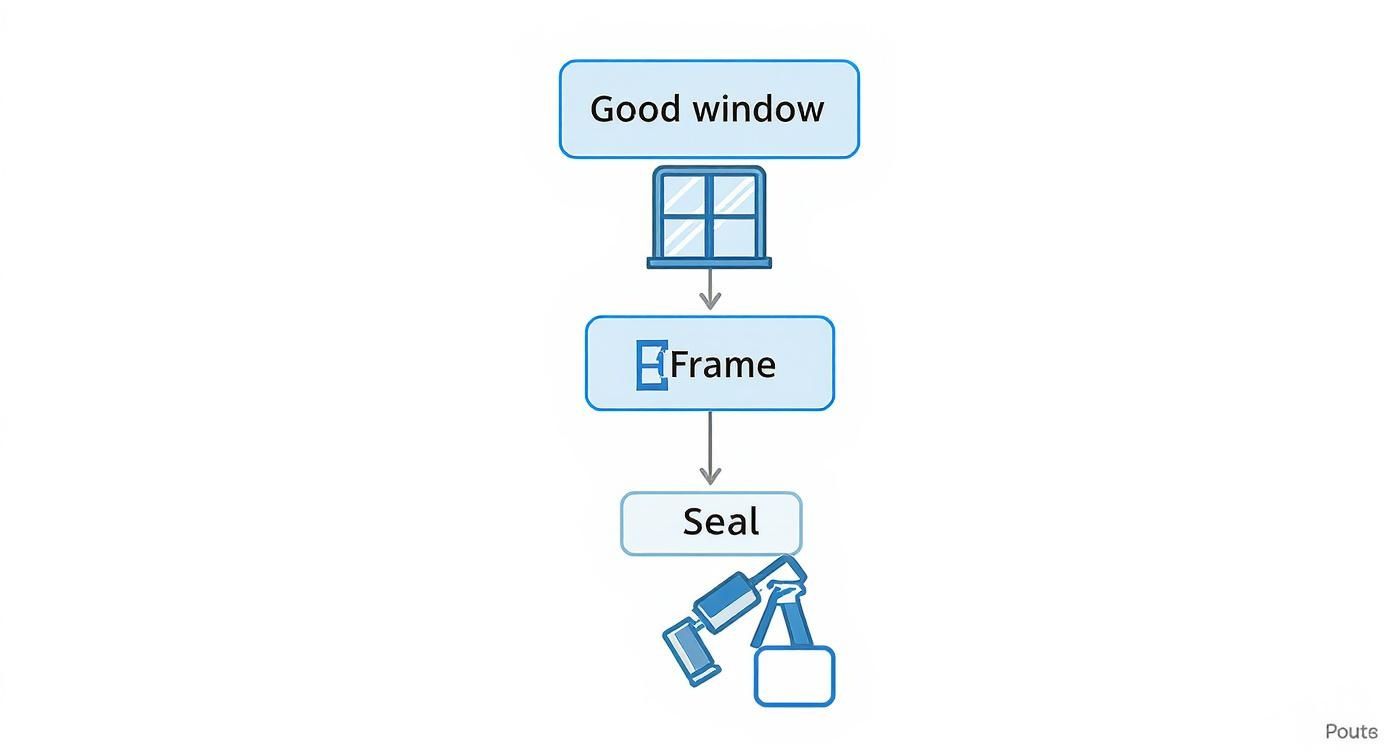
As you can see, even with the best glass and frame, that final, flawless seal is what makes the whole system work. It's the critical last step.
A Holistic Approach to a Quieter Home
Remember, windows are usually the main entry point for noise, but they aren’t the only one. There’s a growing demand for quieter homes, driven by a better understanding of how noise pollution affects our health. While things like soundproof curtains can help, reducing noise by 20% to 50%, they can't make up for a window that's leaking air and sound. A recent industry report from Fortune Business Insights highlights just how much homeowners are prioritizing these solutions.
Choosing the right window is a balancing act between performance, style, and budget. By identifying your specific noise problem and understanding how different window styles create a seal, you can make an informed decision that brings lasting peace and quiet.
Ultimately, you want to create a complete barrier. Whether you go all-in with top-tier sound-dampening windows or boost your current setup with acoustic inserts, a thoughtful approach will give you the quiet home you're looking for.
Got Questions About Noise-Reducing Windows? We’ve Got Answers.
Stepping into the world of soundproof windows can feel a little overwhelming. What really works? Is it worth the investment? We hear these questions all the time, so we’ve put together some straight-to-the-point answers to help you choose with confidence.
Are Triple-Pane Windows Always Quieter Than Double-Pane?
Not always. It’s one of the biggest misconceptions out there. While it feels like three panes should be better than two, what truly matters is the construction of the window, not just the number of glass layers.
A well-designed double-pane window using different glass thicknesses or a laminated pane can run circles around a basic triple-pane window when it comes to blocking noise. The goal is to disrupt as many different sound frequencies as possible. Forget the pane count and look at the official STC and OITC ratings—those numbers don't lie.
How Much of a Difference Does a High STC Rating Actually Make?
Honestly, it’s a night-and-day difference. You don't just hear it; you feel it. Your old, single-pane window might have an STC rating down in the 20s. A modern acoustic window can easily hit 45 or even higher.
Here's the key takeaway: An increase of just 10 points on the STC scale is perceived by our ears as cutting the noise level in half. So, jumping from an STC of 27 to 47 isn't just muffling the traffic—it's creating a whole new level of peace and quiet inside your home.
This is why we stress focusing on the ratings. Those numbers translate directly to real-world tranquility.
Can I Make My Existing Windows Quieter Without Replacing Them?
Absolutely. If a full replacement isn’t in the budget right now, you still have some solid options for turning down the volume.
Acoustic window inserts are one of the most effective solutions. Think of them as a second window installed on the inside of your existing window frame. This creates a huge, sealed air gap that acts as a powerful buffer against sound.
For a smaller investment, you can still get noticeable relief with a few simple upgrades:
- Heavy, sound-dampening curtains: They work by absorbing sound waves that make it into the room, which also cuts down on echo.
- Acoustic sealant: Go around your existing window frames with this specialized caulk. It’s designed to plug the tiny, invisible gaps that let a surprising amount of noise leak through.
While these fixes won't deliver the same performance as a true noise-reducing window, they can make a real, tangible difference.
Ready to bring some peace and quiet into your home? The team at Atomic Exteriors specializes in high-performance windows built to deliver superior noise reduction and energy efficiency. Get your free, no-obligation estimate today and find out just how peaceful your home can be.