.png)
Vinyl Siding Lifespan: What Really Determines It
You're standing in the driveway after a storm, looking at siding that has faded on one wall, buckled near a window, or pulled loose beneath the eaves. The house may not look ready for a full exterior replacement, but you still need to know whether the panels are aging normally or allowing water behind the wall.
That uncertainty is common because vinyl siding lifespan isn't a fixed expiration date. A well-installed, modern system can remain serviceable for several decades, while another installation may develop serious problems much sooner because of ultraviolet exposure, poor attachment, impact damage, or moisture. The right question isn't how old the siding is. It's whether the siding still protects the wall and can be repaired economically.
Why Vinyl Siding Lifespan Is a Range, Not a Date
A warranty, installation year, and general lifespan estimate can set expectations, but none identifies the day replacement becomes necessary. Building-material guidance describes vinyl siding as durable and virtually maintenance-free, with products commonly backed by transferable 50-year or lifetime warranties. That coverage signals a long-term performance expectation, not a guaranteed service date. BuildingGreen's residential siding guidance explains that formulation, exposure, installation quality, and maintenance all influence performance.
Two homes built in the same year can still have very different siding conditions. One may have shaded walls, careful installation, and occasional cleaning. Another may receive strong afternoon sun, repeated storm impacts, loose panels, or water intrusion around trim. Their installation dates match, but their remaining service life may not.
Start with condition, not the calendar
Walk around the house and separate cosmetic aging from functional failure. Fading can change the appearance without immediately affecting the wall. Cracks, brittle panels, buckling, missing sections, and signs of moisture deserve faster attention because they can expose the drainage system behind the siding.
Practical rule: Age tells you when to inspect more carefully. Condition tells you what to do next.
Upstate South Carolina weather makes this distinction especially useful. Sun, humidity, heavy rain, wind, and storm debris test both the material and the installation. A panel may still look acceptable from the street while loose attachment or damaged trim creates a path for water.
The same principle applies to other exterior products. If you're comparing expected service life across materials, a practical resource on how long vinyl fences last can help explain why exposure, installation, and maintenance matter beyond a product label. For a broader comparison of exterior materials, review this guide to the best siding for a home, then assess the specific condition of your walls.
A useful inspection asks three questions: Is the panel intact? Is it still attached correctly? Is there evidence that water has reached the wall behind it? Those answers are more useful than a single brochure number.
What Vinyl Siding Is Made Of and Why That Matters
Modern vinyl siding is made primarily from unplasticized polyvinyl chloride, or U-PVC. Manufacturers engineer this form of PVC for exterior wall cladding, where it must handle sunlight, temperature changes, rain, wind, and occasional impact without regular painting.
The material has changed considerably since it first appeared in the exterior-cladding market. Vinyl entered that market in the late 1950s, and early production associated with Crane Plastics in Columbus, Ohio, had limitations. Pigments were blended manually, which created inconsistent color, and early products had less reliable impact performance. Manufacturing and formulation improvements beginning around 1970 improved impact resistance, production speed, durability, and available color choices. The historical overview of vinyl siding explains why later generations gained wider acceptance.
Product generation changes the comparison
A home sided in the 1960s isn't automatically equivalent to a home sided with a modern product. Early-generation panels may have different color stability and impact performance from newer siding, even if both are still attached to the same wall after many years.
That history matters when buying an older home. Ask whether the visible siding is original, whether a previous owner replaced only one elevation, and whether an addition uses a different profile. A mismatch can reveal more than an appearance problem. It may show that one portion of the house has already reached the end of its useful service while another remains sound.
Look beyond the word vinyl
“Vinyl” describes a material category, not a single performance level. Panel formulation, profile, accessories, fastening, and installation details all influence how the completed system behaves. A homeowner comparing siding options should also understand how manufacturers and contractors discuss product differences, which is addressed in this guide to Norandex vinyl siding.
The practical takeaway is simple: identify the approximate installation period and inspect the material itself. Older siding deserves closer attention to brittleness, fading, and impact damage. Newer siding still needs inspection because a modern panel can fail early if installers overdrive fasteners, restrict movement, mishandle flashing, or leave openings around penetrations.
The Key Factors That Decide How Long Vinyl Siding Lasts
Vinyl siding loses performance through weathering and physical damage, not because a hidden timer reaches zero. Sunlight, heat, rain, wind, dust, and pollutants can contribute to surface degradation and cracking. The rate varies across the same house because each elevation receives a different combination of exposure.
Formulation affects weatherability
A National Institute of Standards and Technology accelerated-weathering and Florida outdoor-exposure study found that titanium dioxide and calcium carbonate content significantly influenced vinyl siding weatherability through chemical interactions with the PVC matrix. That finding means two products labeled vinyl can have materially different service lives. NIST's study of weathering and formulation properties provides the technical background.
You don't need laboratory equipment to apply that lesson. When comparing replacement proposals, ask for the product line, manufacturer information, color limitations, accessory details, and warranty terms. Avoid choosing solely from a color chip or the lowest initial bid.
Exposure is uneven around the house
South- and west-facing walls usually deserve special attention because they receive strong afternoon sunlight. UV exposure can accelerate fading, chalking, and embrittlement. A shaded north-facing elevation may look newer than a sun-baked wall installed at the same time.
Heat creates additional risks near grills, exhaust outlets, dark roofing elements, and windows that reflect concentrated sunlight. Panels can soften, distort, or melt when exposed to unusual heat. Keep grills away from the wall and inspect areas beneath vents or beside reflective glass.
Installation and impact can shorten service life
Vinyl siding needs room to move as temperatures change. Installers who fasten panels too tightly can restrict that movement and contribute to buckling or distortion. Poorly detailed corners, windows, rooflines, and penetrations can also direct water behind the siding.
Storm impacts create a different problem. Hail or wind-driven debris may crack one panel while leaving neighboring pieces untouched. If you're assessing a recent event, this guide to hail damage to siding can help you recognize why a localized repair may be appropriate, while widespread cracking or moisture requires a larger investigation.
How Upstate South Carolina Weather Tests Your Siding
Upstate South Carolina gives exterior cladding a demanding combination of heat, humidity, sunlight, thunderstorms, wind-driven rain, and storm debris. The risks don't appear equally on every wall. A shaded elevation under a deep overhang may remain stable while a west-facing wall near an open yard fades, rattles, and takes repeated impact.
Start with the sun. Strong exposure can change color and make older panels less flexible. Run your hand lightly over a questionable area, without forcing the panel. If it feels unusually brittle or cracks during ordinary movement, treat that as a functional concern rather than a cosmetic one.
Moisture follows openings
Humidity alone doesn't mean vinyl will fail. Vinyl resists water, but the cladding is part of a wall system that depends on overlapping panels, flashing, trim, and a water-resistive barrier. Loose seams and damaged accessories can allow wind-driven rain behind the panels, where the resulting problem may remain hidden.
Check beneath windows, around hose bibs, near exterior lights, and at transitions between siding and rooflines. Bubbling interior paint, musty odors, staining, mold, or soft trim can justify a closer inspection. The siding may look acceptable from the yard while the wall behind it needs attention.
Storms test attachment and impact resistance
Thunderstorms can combine strong gusts with hail or branches. A panel that survives ordinary rain may crack when struck, and a loose section can pull farther away from the wall during the next event. Inspect corners, soffit transitions, gable ends, and open elevations after severe weather.
Heat also matters in smaller, concentrated areas. A grill placed close to the wall or sunlight reflected from a neighboring window can distort a panel even when the rest of the elevation looks normal. For storm-related concerns, an organized storm damage assessment should document visible damage, flashing, trim, and possible moisture paths before repairs conceal evidence.
What a Vinyl Siding Warranty Actually Covers
A siding warranty is a useful document, but it isn't a forecast that your house will need replacement when the stated period ends. A transferable 50-year or lifetime warranty communicates the manufacturer's long-term expectation for the product. It doesn't override installation errors, storm damage, neglected repairs, or conditions excluded by the contract.
Read the warranty in layers rather than stopping at the headline. First, identify what the manufacturer covers. The language may address manufacturing defects, excessive color change, cracking, or other specific failures. It may not cover labor, removal, disposal, matching materials, or damage caused by unusual heat.
Check the conditions behind the promise
Look for these details before relying on warranty coverage:
- Transfer rules: Confirm whether coverage transfers to a new owner and whether registration or paperwork is required.
- Color provisions: Determine how the warranty defines unacceptable fading and whether darker colors receive different treatment.
- Proration: Check whether the manufacturer's obligation changes as the product ages.
- Installation exclusions: Improper fastening, unsuitable substrates, and missing flashing may limit or eliminate coverage.
- Storm exclusions: Hail, wind, falling branches, and other events may be treated separately from manufacturing defects.
- Labor language: Establish who pays for inspection, removal, replacement, and installation.
A strong product warranty can't rescue a poorly installed wall. Correct movement allowances, drainage details, window integration, and trim installation remain essential. Conversely, a well-installed product with a shorter headline warranty may perform better than a premium product installed without attention to those details.
A separate workmanship agreement addresses the installer's work rather than the panel manufacturer's material. This explanation of what a workmanship warranty covers can help you compare contractor proposals without treating every warranty as interchangeable.
Warning Signs That Vinyl Siding Needs Replacement
A faded wall isn't automatically a failed wall. Vinyl remains resistant to insects and water and doesn't require painting, but it can still rattle, crack, melt, or burn. Consumer Reports tests light-colored vinyl samples under 1,000 hours of ultraviolet exposure, approximately twice the strength of ordinary sunlight, and compares exposed panels with unexposed originals to measure color change. Its siding buying guidance notes that cracked or heat-distorted panels warrant prompt repair regardless of age.
Use a simple progression during inspection. Look first, then listen and touch, and finally investigate the wall behind suspicious areas.
Visual signs
Walk the perimeter in daylight and record locations rather than relying on memory.
- Cracks and splits: Small fractures can widen during temperature changes or after another storm.
- Buckling and warping: Distorted panels may reflect heat, restricted movement, or attachment problems.
- Loose or missing pieces: Panels pulling away from the wall can admit wind-driven rain.
- Severe fading or chalking: Color change may be cosmetic, but heavy surface deterioration deserves closer examination.
- Damaged accessories: Broken corner posts, J-channels, window trim, and utility blocks can create openings even when the broad siding field looks intact.
Indoor evidence matters
Check rooms behind damaged exterior areas. Bubbling paint, staining, mold, musty odors, or soft trim can indicate moisture intrusion. Don't cover those symptoms with interior paint before someone traces the water path.
A single cracked panel after hail may be a sensible repair, particularly if matching material is available and the wall behind it is dry. Broader replacement becomes more rational when damage is widespread, panels are brittle across several elevations, matching is impossible, or moisture has affected the substrate and accessories.
A twenty-year-old wall isn't automatically due for replacement, and newer siding isn't automatically sound after a storm.
If you find one questionable area, photograph it with a nearby fixed reference, such as a window or corner. If you find multiple warning signs, arrange a professional assessment before choosing between patching, partial replacement, and a complete siding system.
Maintenance Habits That Maximize Vinyl Siding Lifespan
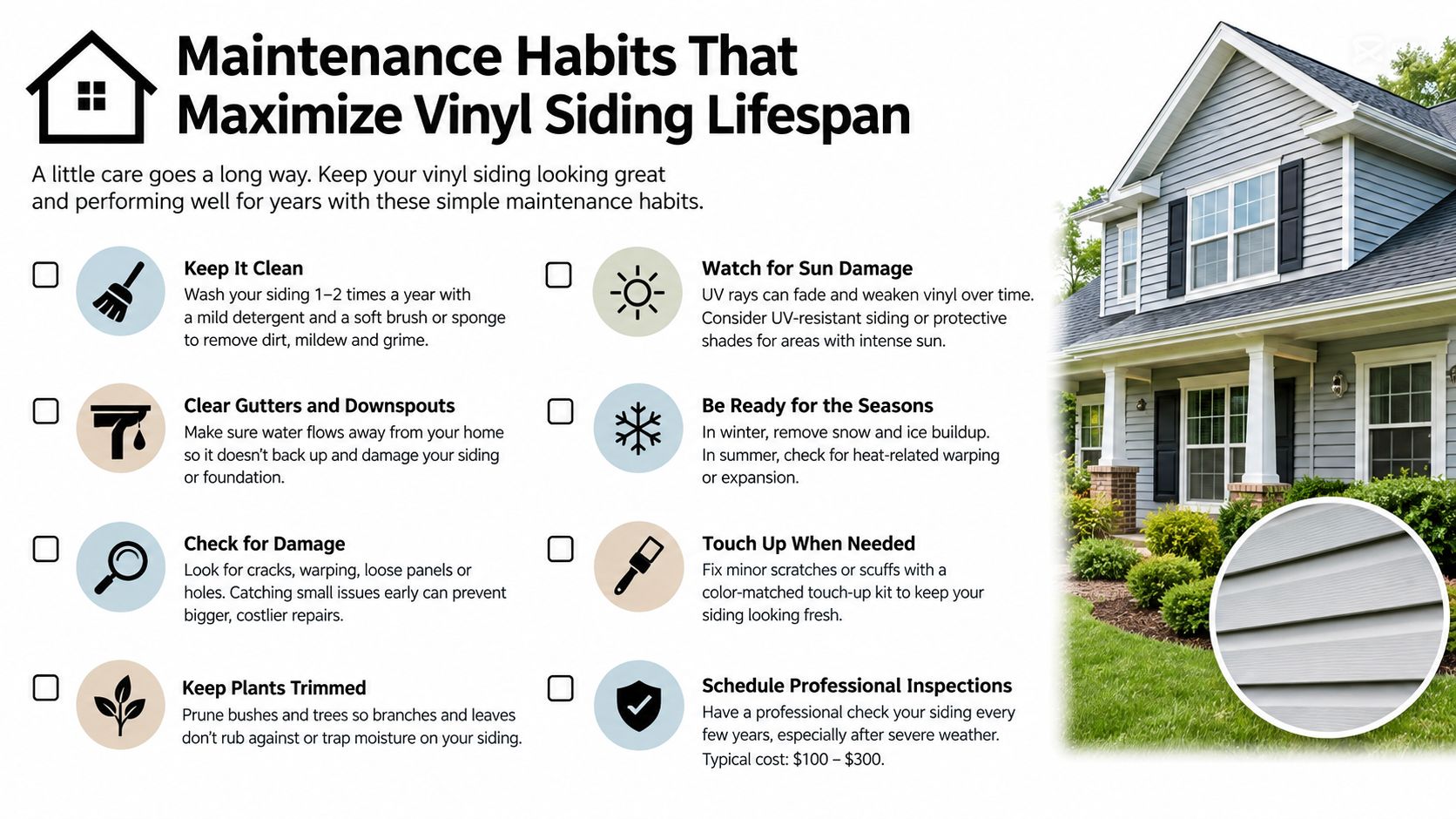
Maintenance won't turn a damaged panel into a new one, but it can prevent small problems from becoming wall repairs. The routine is manageable for a homeowner, landlord, or property manager if it focuses on cleaning, observation, and prompt correction.
Wash the siding gently when dirt, pollen, algae, or other deposits build up. Use a soft brush or a garden hose with a suitable siding cleaner, and follow the product instructions. Aggressive abrasion can damage the surface, while a pressure washer aimed upward can force water behind overlapping panels and trim.
Use a repeatable inspection routine
Walk the exterior during spring and fall, and inspect again after severe weather.
- Check seams and corners: Look for separation, cracked trim, and panels that no longer overlap correctly.
- Examine penetrations: Pay attention to hose bibs, vents, lights, outlets, and cable entries.
- Trim vegetation: Branches and shrubs can scrape the finish, retain moisture, and hide damage.
- Watch heat sources: Keep grills away from siding and inspect areas near exhaust outlets and reflective windows.
- Clear drainage paths: Keep gutters and downspouts directing water away from the wall rather than toward it.
- Record changes: Photograph the same elevations so fading, movement, and new cracks are easier to compare.
Don't use harsh solvents or abrasive tools unless the siding manufacturer specifically approves them. Don't ignore a loose panel because it looks small. Repairing the attachment and replacing a damaged section can reduce the chance that wind-driven rain reaches the drainage plane.
For rental properties, add these checks to the same exterior schedule used for gutters, roof penetrations, and windows. A short written record helps the owner distinguish ordinary wear from a storm event and gives a contractor clearer information when repairs are needed.
A Condition-Based Plan for Your Home
Think of the vinyl siding lifespan as the result of four interacting factors: material formulation, local exposure, installation quality, and care. Inspect the house regularly, repair localized damage promptly, and investigate moisture instead of covering its visible symptoms.
A practical decision rule looks like this:
One isolated defect with no moisture evidence: Consider a matched repair.
Several cracked, warped, loose, or brittle areas: Schedule a broader siding assessment.
Interior staining, bubbling paint, mold, or rot: Inspect the wall assembly and flashing before deciding on cosmetic work.
Storm damage across multiple elevations: Document it promptly and evaluate both the cladding and the drainage details.
A sale, purchase, or major remodel: Obtain a written condition report so your budget and permit planning account for hidden work. This budget and permit planning resource can help organize the broader project.
Upstate South Carolina's sun, heat, humidity, and storms make installation details especially important. When the evidence points beyond a small repair, get an assessment that identifies the damaged panels, accessories, moisture paths, and realistic replacement options.
Atomic Exteriors evaluates aging and storm-damaged siding for Upstate South Carolina homeowners, with vinyl and fiber cement installation, exterior repair planning, and professional workmanship. Visit Atomic Exteriors to request an assessment and discuss the right next step for your home.