.png)
Fiber Cement Siding vs Vinyl Cost A Complete Financial Breakdown
When you’re weighing fiber cement siding vs vinyl cost, the initial price tag tells a simple story: vinyl siding is cheaper right out of the gate. But that’s just the first chapter. The real value unfolds over the life of your home, where fiber cement often delivers a much better long-term return on your investment, thanks to its rock-solid durability and higher resale value.
The True Cost of Siding: A Quick Comparison
Choosing the right siding means looking beyond the sticker price to see the whole financial picture. While the upfront cost is a huge factor for any homeowner, it’s only one piece of the puzzle. A smarter approach is to think in terms of "total cost of ownership," which folds in installation, long-term maintenance, how long the material lasts, and the value it adds to your home when you eventually sell. To really get a handle on the numbers, it helps to know how to estimate construction costs accurately.
Initial Investment vs. Lifetime Value
Let’s get straight to the numbers. Fiber cement siding materials run about $3 to $3.50 per square foot, which is roughly double the price of vinyl at around $1.50 to $1.75. For a full siding replacement project, that translates to $14,961 to $17,008 for fiber cement versus $12,639 to $14,359 for vinyl.
Despite the higher initial spend, fiber cement gives you a stronger return, recouping 77.6% of its cost at resale compared to vinyl's 74.7%. Why the difference? Fiber cement is heavier and requires a more detailed, labor-intensive installation process—factors that contribute to its premium feel, market appeal, and ultimately, its long-term value.
Key Financial Factors at a Glance
To make a truly informed decision, you have to weigh a few key financial metrics side-by-side. This table breaks down the core differences that really impact the total cost over time.
| Upfront Cost | Higher initial material and labor costs | Lower initial material and labor costs |
| Maintenance Needs | Requires repainting every 10-15 years | Requires annual cleaning; no painting needed |
| Expected Lifespan | 50+ years | 20-40 years |
| Resale Value (ROI) | Higher (approx. 77.6%) | Lower (approx. 74.7%) |
This bar chart helps visualize the relationship between what you pay for siding upfront and what you get back when you sell.
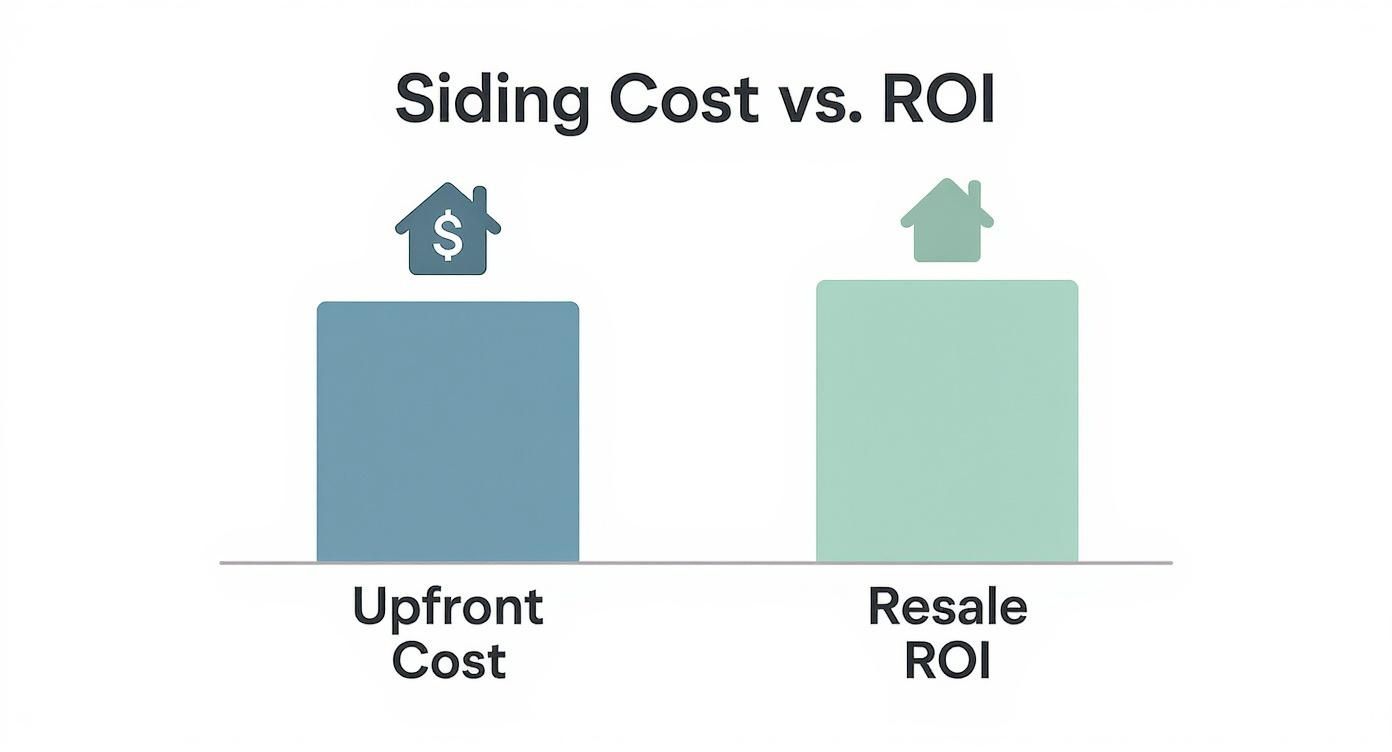
The data makes it pretty clear: while fiber cement asks for a larger investment today, it pays you back a higher percentage of that cost down the road.
The Bottom Line: Your siding decision really needs to line up with your long-term goals as a homeowner. If you prioritize keeping initial spending to a minimum and might not be in the house forever, vinyl is an incredibly practical choice. But for those investing in a “forever home,” the superior durability and higher ROI of fiber cement build a very compelling financial argument.
By looking at all these factors, you can move past a simple price-tag comparison and choose the siding that truly fits both your budget and your plans for your home.
Analyzing Upfront Installation and Material Costs
When you’re weighing fiber cement siding vs vinyl cost, the first number you’ll look at is the upfront investment. It’s what most homeowners focus on, and for good reason. The final quote you get boils down to three things: the siding material itself, the supplies needed to hang it, and the labor to get it done right.
These costs are worlds apart for fiber cement and vinyl, creating a pretty significant price gap right out of the gate.
For homeowners whose primary concern is the initial budget, vinyl siding is the hands-down winner. It’s lightweight, which makes it far easier to transport, handle, and install. That efficiency translates directly into lower labor bills and a faster project from start to finish. Simply put, installers can cover more wall in less time.
Fiber cement, on the other hand, is a much bigger undertaking. Its sheer weight and density demand a whole different level of skill and equipment, which pushes up both the material and labor costs.
Breaking Down Fiber cement Installation Costs
That higher price tag for fiber cement isn't just for show—it’s a direct reflection of the material's heavy-duty nature. A single 100-square-foot section of fiber cement weighs nearly 300 pounds, making it about five times heavier than its vinyl counterpart. This isn't a one-person job; it takes a larger, more experienced crew to manage those boards safely and install them correctly.
On top of that, you can't just cut fiber cement with a regular saw. Because it's a composite of cement, sand, and cellulose fibers, installers need specialized diamond-tipped blades to get clean cuts without creating a plume of hazardous dust. This need for specialized gear and a more skilled team is a major reason for the higher installation price.
The complexity of a fiber cement installation is a key cost driver. It demands more than just extra hands; it requires specialized tools and a level of precision that experienced contractors factor directly into their pricing.
The Simpler Path of Vinyl Installation
Installing vinyl siding is a much simpler affair. It’s so light that a smaller crew can handle it, it cuts easily with standard tools, and the interlocking panel design makes the whole process pretty straightforward. This efficiency is the main reason why the total project cost for vinyl is almost always lower.
But don’t mistake "simpler" for "DIY-friendly." Proper installation is still critical if you want to avoid problems like warping, buckling, or moisture getting trapped behind the panels. Even with its lower cost, hiring a qualified team is the only way to get the most out of your investment. Homeowners in the Upstate SC area can find trusted professionals for siding installation in Arden to ensure the job is handled correctly from day one.
Comparing the Numbers: A Clear Cost Picture
So, what does this all look like in real dollars? Let's get down to brass tacks.
National averages show a full fiber cement siding installation typically lands somewhere between $5 and $14 per square foot. For an average-sized home, you might see a total project cost between $13,543 and $14,674. This premium reflects its incredible durability, resistance to fire and pests, and long-term value.
Vinyl siding is a completely different story. With the material itself starting as low as $0.75 per square foot and much lower labor demands, the total installed cost can easily be half that of fiber cement. This makes vinyl a very attractive option for homeowners working with a tighter immediate budget.
Here’s a clear, side-by-side look at what you can expect to pay upfront.
Detailed Breakdown of Initial Installation Costs Per Square Foot
This table breaks down the estimated material and labor costs for both siding types, giving you a clear view of your initial investment.
| Material Cost | $3.00 - $6.00 | $0.75 - $2.50 |
| Labor & Supplies | $2.00 - $8.00 | $1.50 - $4.00 |
| Total Installed Cost | $5.00 - $14.00 | $2.25 - $6.50 |
When you just look at the upfront numbers, vinyl is the more affordable choice, no question. But this initial savings is only one piece of the puzzle. It’s crucial to weigh that against the long-term performance, durability, and eventual return on investment that fiber cement brings to the table.
Calculating the True, Long-Term Cost of Ownership
That final invoice for your new siding? That’s just the starting line, not the finish. To really get to the bottom of the fiber cement siding vs vinyl cost debate, you have to look past the upfront price and consider the total cost of ownership (TCO). This is the number that matters over the decades you'll be living in your home, and it often shows that the cheapest option today isn't the most economical choice down the road.
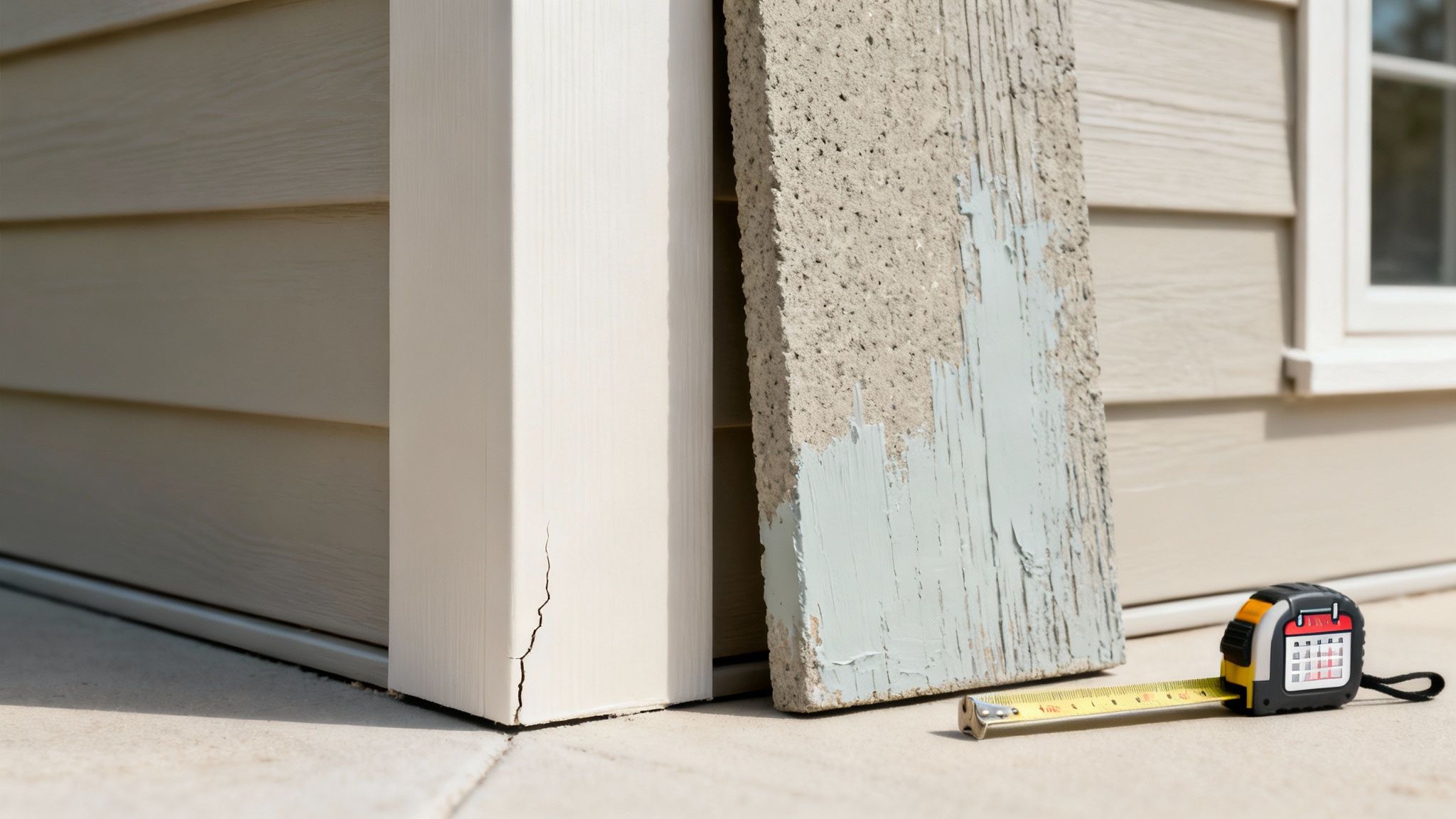
A siding’s lifespan is the bedrock of its long-term value. Fiber cement is engineered to go the distance, with a typical lifespan of 50 years or more. On the other hand, vinyl siding usually starts showing its age—fading, cracking, or warping—after about 20 to 40 years. That durability gap is huge. It means you could end up replacing your vinyl siding twice in the time a single fiber cement installation would last.
Maintenance and Repair Financials
The cost of upkeep is where these two materials really diverge over the years. Vinyl has a reputation for being low-maintenance for a reason; all it really needs is an annual wash-down with soap and water to look fresh. The biggest long-term savings? It never needs to be painted.
Fiber cement, while tough as nails, does require a fresh coat of paint every 10 to 15 years to protect its finish and keep the color looking sharp. A professional paint job isn't cheap, adding thousands to your TCO calculation each time it comes due. But there's an upside: it gives you a chance to completely refresh your home's exterior color without a total replacement.
When it comes to taking a hit, fiber cement has a clear edge. It's built to resist impacts from hail, errant baseballs, and falling branches far better than vinyl, which can easily crack, dent, or puncture under the same kind of stress.
Trying to replace a single cracked vinyl panel can be a real headache, especially after a few years of sun exposure have faded the original color. Getting a perfect match is next to impossible. Repairing a damaged section of fiber cement is usually much more straightforward, making it a more resilient and cost-effective exterior over its lifetime. Making smart material choices is a core part of learning how to increase property value for the long haul.
Factoring in Durability and Other Hidden Costs
Durability isn't just about how long siding lasts; it's about how well it stands up to common threats that trigger expensive repairs.
- Pest Resistance: Fiber cement is completely impervious to termites, woodpeckers, and other pests. You'll never have to worry about the costly pest control and repair bills that can come with other materials.
- Weather Performance: In climates with four distinct seasons, vinyl can get brittle and crack in the winter cold or warp in the summer heat. Fiber cement stays completely stable, no matter the temperature.
- Fire Safety: This is a big one. Fiber cement is non-combustible and boasts a Class A fire rating, a feature that can ripple out to affect other homeownership costs.
Thinking about the true cost of ownership means looking at everything, including the average homeowner insurance cost. Many insurance companies actually offer discounts for homes clad in fire-resistant materials like fiber cement. It might seem like a small savings each year, but over decades, it really adds up. When you combine that financial perk with its incredible lifespan and lower repair needs, fiber cement starts to look like a powerful long-term investment, even with its higher initial price tag.
How Siding Impacts Home Resale Value and ROI
When you're weighing fiber cement siding vs. vinyl cost, the conversation has to go beyond the initial price tag. It's really about the long-term financial picture. The siding you choose is far more than a simple protective shell; it's a major investment that directly shapes your home's curb appeal, its marketability, and, of course, its final sale price.
The return on investment (ROI) is where the higher upfront cost of fiber cement really starts to make sense.
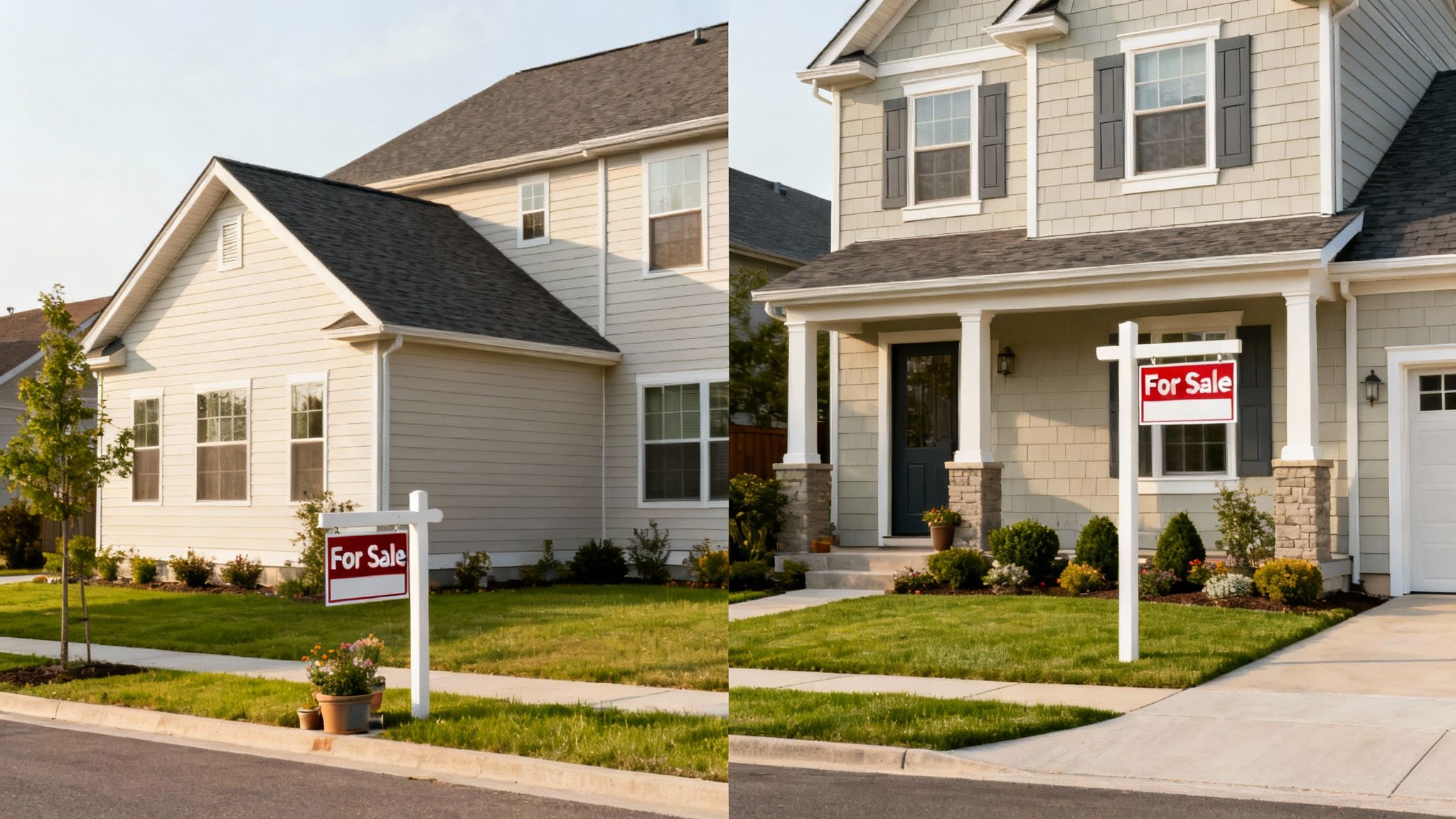
The numbers back this up. National data consistently shows fiber cement siding projects recoup a greater percentage of their cost when a home is sold. This isn't an accident—it comes down to how potential buyers perceive the quality and durability of a home's exterior.
The Value of Perceived Quality
Buyers see fiber cement and think "premium." They associate it with durability and a high-end finish. Because it can so perfectly mimic the rich, textured look of real wood without all the maintenance headaches, it gives a home a solid, upscale feel that really pops on the market. That aesthetic punch is a huge advantage when you plant a "For Sale" sign in the yard.
Vinyl siding, on the other hand, is seen as functional and budget-friendly. While there’s nothing wrong with it, buyers often view it as a standard, builder-grade finish. It doesn't usually deliver that "wow" factor that convinces a buyer to bump up their offer. In a crowded market, a home with fiber cement has a clear advantage over a similar house wrapped in vinyl. To dig deeper into making your exterior pop, you can learn how to improve curb appeal with other smart upgrades.
Comparing ROI By the Numbers
The financial return is where these two materials really part ways. While the exact numbers shift with the market, the trend is always the same.
- Fiber Cement ROI: Homeowners can expect to get back around 75% to 85% of what they paid for the project. In some hot markets, we’ve seen it go even higher. Its long life and tough-as-nails nature assure buyers they won't be facing a huge replacement bill anytime soon.
- Vinyl Siding ROI: The return here is still solid, usually landing in the 65% to 75% range. It’s a safe, dependable choice, but it rarely adds value beyond just doing its job.
A siding replacement project isn't just an expense; it's an asset. Fiber cement's superior ROI means that a larger portion of your upfront cost is returned to you when you sell, effectively reducing its true long-term cost.
This ROI gap is driven by more than just good looks. Smart buyers and their home inspectors know the practical benefits of fiber cement, like its Class A fire rating and its resistance to pests, rot, and impact damage. Those features mean lower maintenance and greater peace of mind—two things that make a home a much more compelling purchase.
Real-World Scenarios and Buyer Psychology
Let's play this out. Imagine two nearly identical homes for sale on the same street. One has clean, basic vinyl siding. The other features deep-colored fiber cement siding with crisp, modern trim.
The fiber cement home immediately screams quality. A buyer walking up to it might think, "The owners invested in the good stuff here; I wonder what other high-quality features are inside?" That powerful first impression can lead to a faster sale and a better offer.
The vinyl-sided house is perfectly fine, but it doesn't spark that same confidence or emotional connection. It meets expectations; it doesn't exceed them. That subtle difference in perception is exactly where fiber cement's higher resale value comes from. For a seller, it can mean thousands of extra dollars at the closing table, making that initial investment a very wise financial move.
Uncovering the Hidden Financial Factors in Your Decision
When you're weighing fiber cement siding vs vinyl cost, the initial quote for materials and labor is just the opening act. There's a whole second half to the financial story—one that plays out over years in ways most homeowners never see coming.
These "hidden" costs and benefits are where the real value of your investment is determined. From insurance discounts to your monthly power bill, the siding you choose creates financial ripples across your entire household budget. Let's break down the less obvious impacts so you can make a decision that pays off in the long run.
Insurance Premiums and Siding Material
Here’s a factor that rarely makes it into a siding estimate: your homeowner's insurance policy. Insurance companies are all about managing risk, and your home’s exterior is a massive part of their calculation, especially when it comes to fire and storm damage.
Fiber cement has a major ace up its sleeve here—it boasts a Class A fire rating. In plain English, that means it’s non-combustible. It won’t ignite, even when hit with a direct flame. This isn't just a safety feature; it's a financial one.
Many insurance providers offer real, tangible discounts for homes clad in fire-resistant materials. While today’s vinyl siding is more fire-resistant than its predecessors, it's still a combustible plastic that will melt and warp in high heat. Insurers see that as a higher risk.
Over the 30-year life of a mortgage, that small annual premium reduction for choosing fiber cement can easily add up to thousands of dollars in savings, quietly chipping away at its higher upfront cost.
Energy Efficiency and Your Power Bill
Your siding choice also plays a direct role in how hard your HVAC system has to work every month. While neither standard vinyl nor fiber cement are insulators by themselves, they contribute to your home's energy envelope in different ways.
Insulated vinyl siding, which comes with a contoured foam backing, is specifically engineered to boost your home's R-value. It helps stop "thermal bridging"—the process where heat escapes through the wall studs—and keeps your conditioned air right where you want it: inside. In a place with hot summers and chilly winters, that can make a noticeable difference.
Fiber cement, being thick and dense, provides a bit of thermal mass. But its real energy efficiency shines when it’s installed over a continuous insulation system. When a professional crew pairs it with the right underlayment, you get a nearly airtight barrier against air and moisture, seriously beefing up your home's overall efficiency.
Permits, Disposal, and Those "Surprise" Costs
Finally, let's talk about the miscellaneous costs that tend to pop up mid-project. These are the expenses people often forget to budget for, but they are an unavoidable part of any major siding replacement.
- Permitting Fees: Most cities and counties require a permit for siding work to ensure everything is up to code. These fees can range from less than $100 to several hundred dollars, depending on where you live.
- Old Siding Disposal: You have to do something with all that old siding, and getting rid of it costs money. Because it’s so much heavier, disposing of old fiber cement or wood siding can sometimes cost more than hauling away lightweight vinyl.
- Structural Prep Work: This is the big unknown. Once the old siding comes off, the crew might find rot or other structural damage to the sheathing underneath. Those repairs must be done before the new siding goes on, and it’s an unpredictable cost you need to be ready for.
These pieces of the puzzle, along with other key exterior systems, all factor into your home’s total cost of ownership. For a closer look at another vital component, check out our guide on the cost of seamless gutters—they work hand-in-hand with your siding to protect your foundation and walls.
Making the Right Financial Choice for Your Home
When you're weighing fiber cement siding vs. vinyl cost, it all boils down to your own situation. There's no single "best" financial decision here—the right choice is the one that fits your budget, your timeline, and what you want to get out of your property.
This isn't just about picking the cheapest material or the strongest one. It’s about matching the product's financial lifecycle to your own plans for the home.
The Short-Term Homeowner or Budget-First Remodeler
Let's imagine you're planning to sell your house in the next five to seven years, or you're working with a tight, immediate budget for a remodel. In this case, the financial logic points straight to vinyl siding.
- Upfront Savings: The initial installation cost is significantly lower. This lets you give your home a complete exterior facelift without draining your bank account, freeing up cash for other projects that add value, like a kitchen update or new landscaping.
- Immediate ROI: While its long-term return on investment doesn't match fiber cement, vinyl gives you an instant boost in curb appeal that buyers notice. It makes the home market-ready for a minimal expense.
- Maintenance-Free Appeal: For a short ownership window, the zero-maintenance aspect of vinyl is a huge plus. You don't have to worry about factoring in future painting costs, which keeps the financial picture clean and simple.
For this type of homeowner, the higher investment for fiber cement just doesn't have enough time to pay for itself through increased resale value or long-term durability.
The "Forever Home" Investor or Durability-Focused Builder
Now, let's flip the script. Picture a family building their dream home where they plan to live for decades. Or maybe a homeowner in an area like the Upstate that gets its fair share of hailstorms and high winds. Here, the financial equation looks completely different, and fiber cement becomes the smarter long-term investment.
The higher upfront cost is better seen as a down payment on decades of security and performance.
Choosing a siding material is a long-term financial commitment. For those staying in their home for 15+ years, fiber cement's superior lifespan and durability often result in a lower total cost of ownership, despite the higher initial price.
This long-game perspective shifts the priorities.
- Lifetime Value: With a lifespan that can exceed 50 years, a single fiber cement installation can easily outlast two full cycles of vinyl siding. That means you avoid an expensive and disruptive replacement project down the road.
- Superior ROI: The higher resale value becomes a real asset, protecting your home's equity over the long haul. Appraisers and savvy buyers recognize the premium quality.
- Reduced Risk: Its resistance to impact, fire, and pests means fewer surprise repair bills. This creates a much more predictable and stable budget for long-term maintenance.
For this homeowner, vinyl's upfront savings are a false economy. It could easily lead to higher costs and more headaches over the life of their home.
Your Decision-Making Checklist
To figure out what’s right for you, ask yourself these key questions. Your answers will point you toward the best path for your specific situation.
How long do I plan to live in this house? (Less than 10 years usually favors vinyl; more than 15 years leans toward fiber cement).
What is my absolute maximum upfront budget? (If the budget is tight and fixed, vinyl is often the necessary choice).
Is my region prone to severe weather like hail or high winds? (A "yes" here strongly suggests fiber cement for its durability).
How important is a premium, high-end look? (Fiber cement delivers more depth and authentic-looking textures).
Am I willing to budget for repainting every 10-15 years? (If that sounds like a hassle you want to avoid, vinyl is the better option).
Ultimately, the only way to get real numbers is to talk to a professional. A detailed, project-specific estimate is the critical next step to finalize your budget and make a confident decision for your home’s future.
Siding Cost Questions We Hear All the Time
When you're digging into a siding project, the numbers can be a lot to juggle. It's completely normal to have questions as you weigh the fiber cement siding vs. vinyl cost. We get these all the time from homeowners in the Greenville area, so let's clear up a few of the most common ones.
Will Fiber Cement Siding Actually Increase My Home's Value More Than Vinyl?
Yes, in most cases, it absolutely will. Real estate professionals and appraisers see fiber cement as a premium building material, not just a cosmetic covering. Its ability to convincingly mimic real wood, paired with its incredible durability and fire resistance, adds tangible value to a home appraisal.
The data backs this up. National reports consistently show that fiber cement siding projects recoup a significant portion of their cost at resale—often more than 75%. Vinyl, on the other hand, is usually seen as a standard, builder-grade finish. It does its job and maintains your home's value, but it rarely adds to it in a meaningful way.
Is Fiber Cement Maintenance Really That Expensive?
While it’s not zero-maintenance like vinyl, the upkeep is predictable and totally manageable. The main long-term cost you’ll have is repainting, which is typically needed every 10 to 15 years to keep the finish looking sharp and fully protected.
You'll want to factor that future painting cost into the total lifetime expense. But here's the trade-off: fiber cement is exceptionally resistant to rot, pests, and impact damage. That means you'll spend far less money and time on surprise repairs compared to vinyl, which can get brittle, crack, or puncture more easily over the years.
The key takeaway is that fiber cement's maintenance is proactive (painting on a schedule) rather than reactive (fixing unexpected damage). This planned upkeep is almost always offset by its much longer lifespan and the costly repairs you get to avoid.
Why Is the Labor Cost to Install Fiber Cement So Much Higher?
This is a great question, and it comes down to three things: the material's weight, the specialized tools needed, and the skill level required to do it right.
Sheer Weight: Fiber cement is a beast. It weighs around 300 pounds per 100 square feet, which is way heavier than vinyl. This means you need a larger, stronger crew just to handle and position the boards safely and accurately.
Specialized Tools: You can't just cut this stuff with a standard saw. To get clean, precise cuts without creating a cloud of hazardous dust, installers need diamond-tipped blades. This professional-grade equipment costs more and adds to the contractor's overhead.
No Room for Error: Fiber cement is far less forgiving than vinyl. Every nail has to be driven perfectly, and the detailing around windows and corners must be precise to prevent any chance of moisture getting behind the boards. This demands a crew with real experience and skill.
All these factors add up to more time, more expertise, and more manpower on the job site—which is directly reflected in the labor quote.
Is Insulated Vinyl Siding a Smarter Choice for Energy Savings?
For pure energy efficiency, insulated vinyl siding can be an excellent choice. In some cases, it can even outperform a standard fiber cement installation. That contoured foam backing is great at reducing "thermal bridging," which is just a technical term for heat escaping through your home's wall studs.
The right choice really boils down to your priorities. If getting the biggest energy savings on a tighter budget is your number one goal, insulated vinyl is a very strong contender. But if you're looking for a balance—good thermal performance combined with superior durability, fire resistance, and a much longer lifespan—then fiber cement is still the more robust long-term investment for your home.
Ready to get a clear, accurate estimate for your home? The team at Atomic Exteriors provides honest, upfront pricing and expert guidance to help you make the best choice for your budget and long-term goals. Contact us today for a free, no-obligation consultation.