.png)
Siding replacement cost calculator: Budget Your Project
Wondering what a siding replacement might cost? A siding replacement cost calculator is a fantastic first stop for wrapping your head around a budget. It’s designed to give you an instant ballpark estimate based on a few key details, like your home's size, the material you’re eyeing, and our local labor rates right here in the Upstate.
What to Expect from a Siding Replacement Cost Calculator
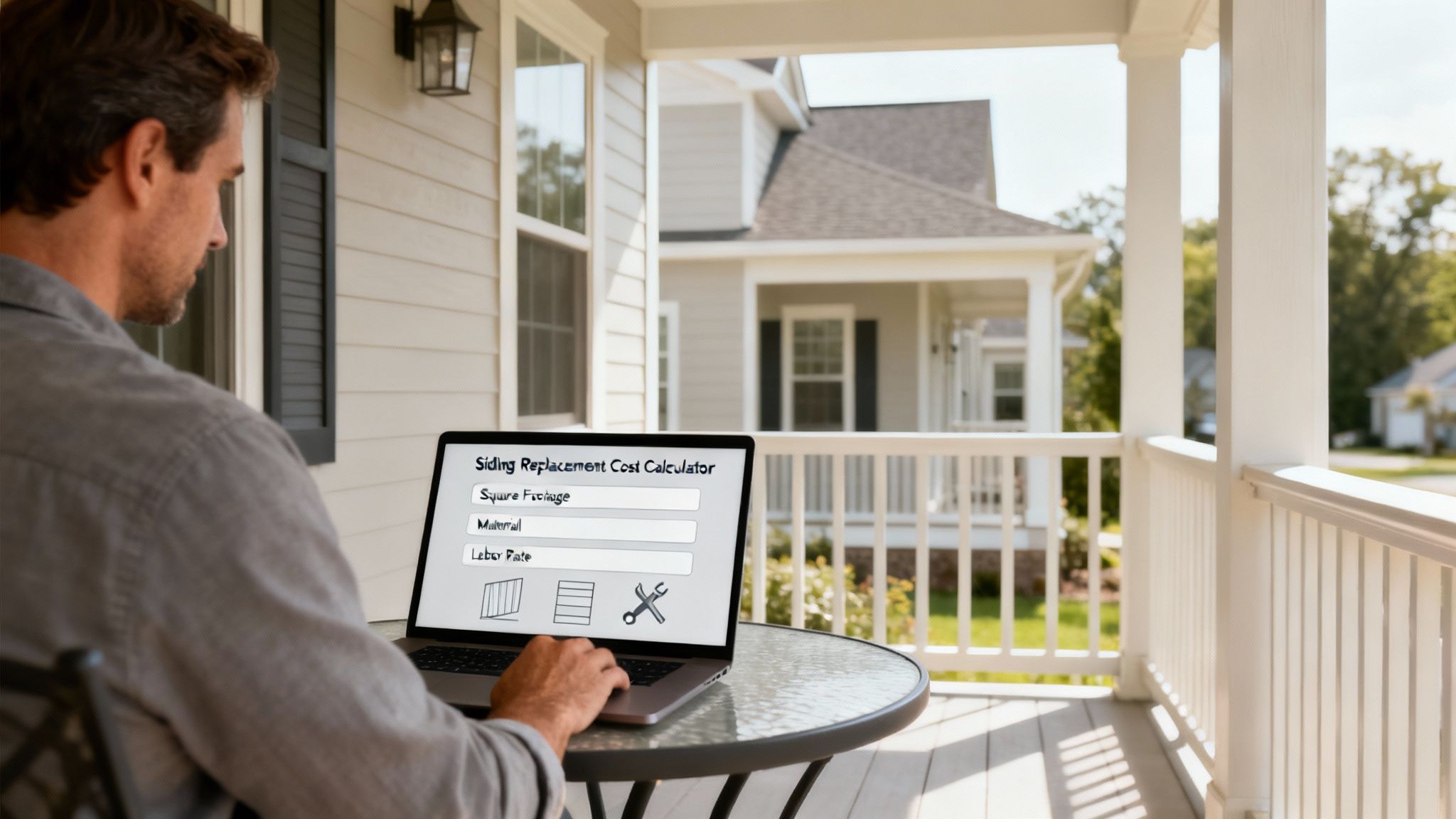
Think of a siding replacement cost calculator as your initial planning guide, not a final, set-in-stone quote. Its job is to give you a realistic budget range by crunching the numbers on the most common factors that drive the total price of a new siding installation.
So how does it work? The tool takes the information you provide—like the rough square footage of your house and the type of siding you're considering—and meshes it with pre-loaded regional cost data. This gives you a clear financial snapshot before you even pick up the phone to talk to a contractor.
The Purpose of a Calculator Estimate
The whole point is to put information in your hands. Instead of guessing, you can play around with different scenarios. For example, you can instantly see how choosing a premium fiber cement siding compares financially to a budget-friendly vinyl option. This lets you line up your dream project with your financial comfort zone, right from the get-go.
If you want to get a feel for what’s out there, you can learn more about the different siding options and materials we install. It’ll help you make a more informed choice when using the calculator.
A calculator provides an excellent preliminary estimate. It's the essential first step that helps you budget confidently, but it can't account for unique architectural features or hidden issues that only an on-site inspection can reveal.
Key Variables Driving Your Siding Replacement Cost
A siding cost calculator is only as good as the information it uses. While every tool is a little different, they all rely on a core set of data points to generate an estimate. We've put together a quick table to show you exactly what's moving the needle on your project's price.
| Home Size | The total exterior wall square footage is the single biggest factor influencing both material and labor costs. | High |
| Siding Material | The cost per square foot varies dramatically between vinyl, fiber cement, engineered wood, and other options. | High |
| Labor Rates | This reflects the average cost to install siding in a specific region, like Upstate South Carolina. | Medium |
| Trim & Accents | The cost of trim boards for corners, windows, and doors, plus any decorative elements. | Medium |
| Insulation | Adding rigid foam insulation under the new siding improves energy efficiency but adds to the upfront cost. | Medium |
| Old Siding Removal | The cost to tear off and dispose of the existing siding material. | Low-to-Medium |
| Permits & Fees | Local municipalities often require building permits for siding replacement projects. | Low |
At the end of the day, that number you see on the screen is a powerful budgeting tool. It transforms a big, unknown expense into a tangible figure you can work with. It sets the stage for a productive conversation with a professional who can then provide a precise, detailed quote tailored specifically to your home.
Breaking Down the Numbers Behind Your Estimate
Think of a siding replacement cost calculator like a recipe. The final price tag depends entirely on the ingredients you put in. To get a number you can actually trust, you need to understand what those "ingredients" are and how each one nudges the cost up or down.
By breaking down the inputs, a vague number starts to look more like a clear financial roadmap. It empowers you to use any online tool more effectively and gives you a real feel for where your investment is going. Let's pull back the curtain on the main components every good siding calculator uses to build your estimate.
Home Size: The Foundation of Your Cost
The first and most important number is your home's exterior square footage. This single measurement is the foundation for almost every other part of the estimate, from how much siding material we'll need to the total hours of labor it will take to get the job done.
Siding is sold and installed by the square foot—it’s that simple. A sprawling two-story home will naturally need a lot more material and time than a cozy single-story ranch. Nailing down this number is the critical first step to getting a useful ballpark figure from any siding replacement cost calculator.
Siding Material: The Biggest Price Variable
Your choice of siding material is easily the biggest factor that will swing the total cost of your project. The price gap between different materials can be huge, directly impacting your upfront investment and your home’s long-term value.
Here’s a quick look at the most common options and how they affect the budget:
- Vinyl Siding: Often the most budget-friendly choice, vinyl gives you excellent value and low maintenance. It's a popular pick for homeowners focused on affordability and instant curb appeal.
- Fiber Cement Siding: This is a premium material, like the products from James Hardie. It costs more upfront but pays you back with superior durability, fire resistance, and a much longer lifespan. It’s an investment in pure performance.
Getting the difference between these is key. For a much deeper dive into how these two popular options stack up financially, check out our guide comparing the cost of fiber cement siding vs vinyl. This will help you balance your budget with your long-term goals for your home.
Trim, Soffits, and Finishing Touches
The big siding panels cover the broad surfaces, but the job isn't done without the finishing touches. These smaller components are absolutely essential for both the final look and for protecting your home from the weather.
Trim, soffits, and fascia are the architectural details that frame your home. They seal vulnerable joints around windows, doors, and rooflines, preventing water intrusion while adding crisp, clean lines to your home’s exterior.
Forgetting to account for these elements will give you an incomplete and misleading estimate. They require different materials and specialized labor, so make sure your calculation includes the cost of replacing corner boards, window trim, and the materials covering the underside of your roof's eaves (the soffits).
Removal and Disposal of Old Materials
Finally, what happens to your old, worn-out siding? It has to be carefully torn off, and all that debris needs to be hauled away and disposed of properly. This process is a crucial part of the job that adds to the overall labor and disposal fees.
The difficulty of removal can change depending on what's currently on your house. For instance, taking off brittle, old wood siding can be a lot more work than removing vinyl. A good siding cost calculator will always factor in this necessary step to give you a more complete and realistic project total.
Choosing Your Material: Vinyl vs. Fiber Cement
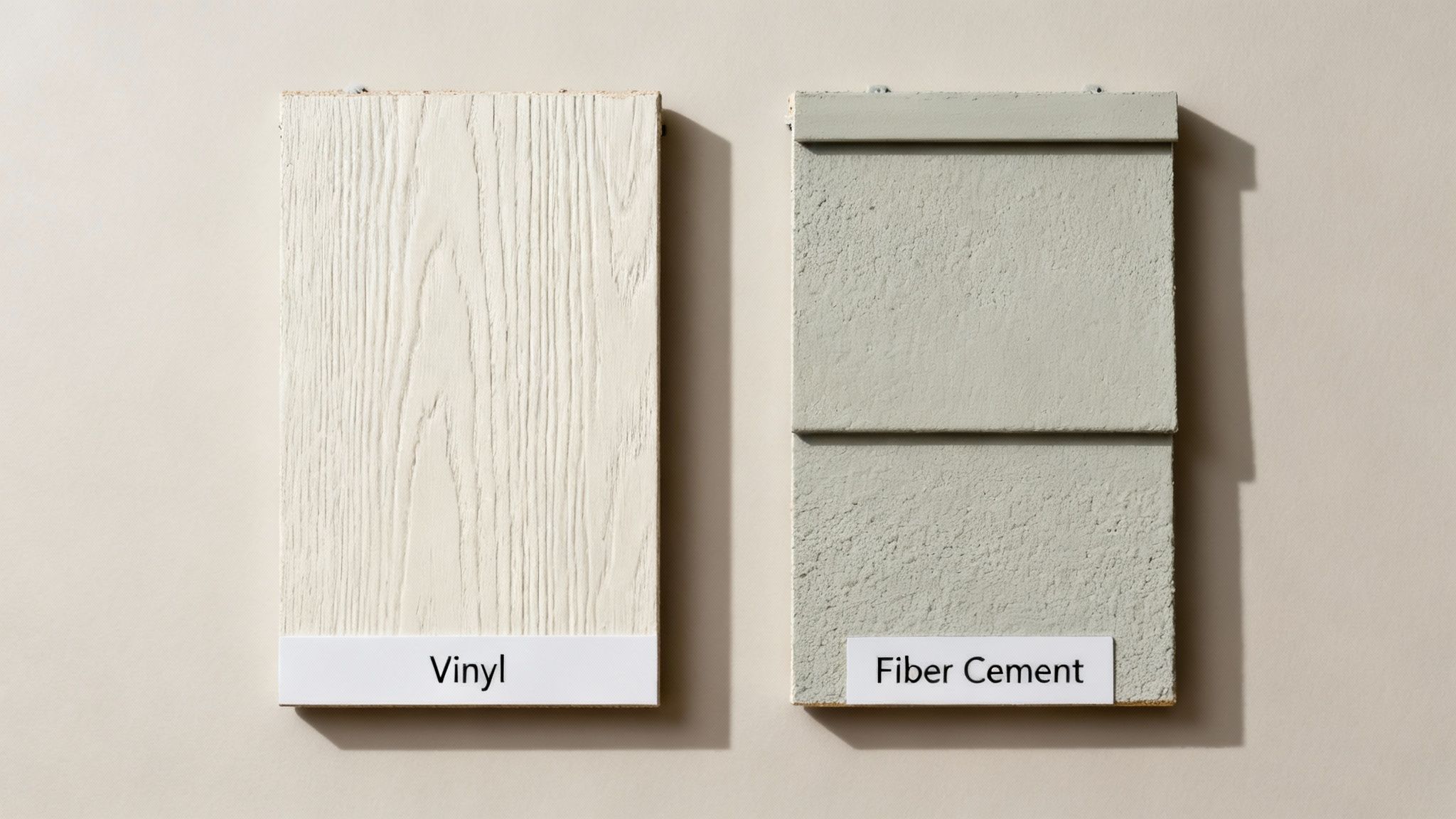
The single biggest decision you’ll make for your siding project is the material you choose. It's the primary driver of your budget, and it will define your home’s curb appeal and long-term performance for years to come.
Here in Upstate SC, the choice usually boils down to two heavy hitters: versatile, affordable vinyl and durable, premium fiber cement.
Your decision here is about more than just the numbers a siding replacement cost calculator spits out. It’s about what you want your investment to do. Are you looking for a fast, budget-friendly facelift to help sell the house? Or are you digging in for the long haul, investing in decades of resilience against our region's humidity and unpredictable weather?
Let's break down the trade-offs.
The Case for Vinyl Siding
When it comes to affordability, vinyl siding is the undisputed champion. It’s the go-to choice for homeowners who need to make a big impact without a massive price tag.
Its low upfront cost, nearly non-existent maintenance, and a huge variety of colors and styles make it an easy win. For many, it hits that perfect sweet spot between price and performance, offering an immediate aesthetic upgrade that works. It’s a favorite for first-time buyers and property investors looking to boost curb appeal efficiently.
Generally, you can expect the installed cost for vinyl to range from $3 to $12 per square foot. For a typical 2,000-square-foot home, that puts the average project cost somewhere between $6,000 and $24,000. Economy grades can bring that number down even further, especially if you're just prepping a property for a quick sale.
Key Takeaway: Vinyl siding offers an unbeatable value proposition for anyone prioritizing upfront cost. It’s a fantastic way to refresh your home's look quickly and affordably, delivering a strong return on a modest investment.
The Power of Fiber Cement Siding
On the other end of the spectrum, you have fiber cement—a material engineered for sheer longevity and strength. Think James Hardie products.
This isn’t just siding; it's armor. Made from a composite of cement, sand, and cellulose fibers, it’s built to laugh off harsh weather, resist rot and pests, and it won't burn.
While the upfront cost is higher than vinyl, that investment pays you back over the long term. Fiber cement delivers superior durability, holding its shape and finish for decades with minimal care. It also provides a more substantial, high-end look that can seriously elevate a home's value. If you want to dive deeper, we have a whole article that lays out the pros and cons of fiber cement siding.
Making the Right Choice for Your Home
So, which one is right for you? A siding cost calculator can show you the price difference, but only you can decide which path makes sense for your home and your budget.
Here’s the final breakdown:
- Budget vs. Longevity: Vinyl is the clear winner for immediate affordability. Fiber cement is the undisputed champ for long-term durability and lower lifetime costs.
- Aesthetics and Value: Both materials can look fantastic, but fiber cement often provides a more premium, authentic finish that can command a higher resale value.
- Maintenance: Both are refreshingly low-maintenance. The biggest difference is that fiber cement may need a new coat of paint after 15-20 years, whereas vinyl’s color is baked in for good.
Ultimately, this choice will define your home's character and its first line of defense for decades.
How Local Labor Rates Impact Your Final Cost
An online siding replacement cost calculator is a fantastic starting point. It gives you a solid ballpark figure based on national averages. But here’s the thing: your project isn’t happening “on average”—it’s happening right here in Upstate South Carolina. And that’s where local market conditions come in and really shape the final price.
Think of it like this: the cost for a bundle of vinyl or a plank of fiber cement siding is pretty similar whether you're in California or the Carolinas. What's not similar is the cost of the skilled hands needed to install it perfectly. The local labor rate is almost always the biggest variable, and it's why a project in Greenville can cost thousands less than the exact same job in Miami or Denver.
Why Upstate SC Labor Rates Are Unique
Several local factors tweak the labor portion of your siding bill. Getting a handle on these will help you set a much more realistic budget for your home, whether you're in Anderson, Simpsonville, or Greer.
Here are the key drivers in our area:
- Demand for Skilled Installers: A busy housing market means more competition for top-tier, experienced siding crews, which can influence their rates.
- Regional Supplier Networks: We have great local distributors, and their pricing and material availability can affect a contractor's overhead costs.
- Local Building Codes: Following specific Upstate SC building codes isn't optional. It requires expertise and can impact how long an installation takes and the techniques used.
The global siding market is growing fast, with projections showing it could hit $160.67 billion by 2032. While the average U.S. siding replacement runs about $11,576, prices can swing wildly from one region to the next. The good news? The Southeast, including South Carolina, often has more competitive labor rates than higher-cost markets on the coasts. You can see more about regional siding cost variations on Angi.com.
The Value of a Local Contractor
This is exactly why working with a licensed, local contractor is so critical. An online tool can’t possibly know the subtle ins and outs of working in the Upstate. A local pro, on the other hand, deals with these details every single day. They know the best suppliers, understand exactly what it takes to meet local codes, and have a crew that’s experienced with our specific climate.
That deep-rooted expertise ensures your project is priced accurately from day one, heading off any nasty surprises later on. You can learn more about finding the right team in our guide to choosing local siding contractors near you. In the end, a local expert is the one who can translate that broad estimate from a calculator into a precise, reliable quote built just for your home and our community.
Visualizing Siding Costs for Upstate SC Homes
Talking about costs in terms of "per square foot" is a good start, but it doesn't really paint a clear picture. It's like knowing the price of a gallon of paint but not how many gallons you'll need. A siding replacement cost calculator helps bridge that gap, turning abstract figures into a real-world estimate you can actually use for budgeting.
Let’s walk through a few common scenarios for homes right here in the Upstate. These examples will show you how the two biggest cost drivers—your home's size and the siding material you choose—stack up in the real world. Whether you have a cozy ranch or a sprawling two-story, these numbers will give you a solid starting point.
Estimated Siding Replacement Cost in Upstate SC
To make things simple, here’s a quick-glance table comparing project costs for different home sizes. You can see the immediate difference between budget-friendly vinyl and premium, ultra-durable fiber cement.
| 1,500 | $6,000 – $13,500 | $10,500 – $21,000 |
| 2,200 | $8,800 – $19,800 | $15,400 – $30,800 |
| 3,000 | $12,000 – $27,000 | $21,000 – $42,000+ |
These ranges give you a practical ballpark to start from. Now, let's break down what goes into those numbers for each home size.
Cost Scenario 1: The 1,500 sq. ft. Ranch
The single-story ranch is a staple in our area, and its straightforward design usually makes siding installation pretty efficient. No complex angles, no second-story scaffolding—just a clean, simple job.
- Vinyl Siding: For a classic 1,500 sq. ft. home, a standard vinyl siding replacement will typically run you between $6,000 and $13,500. This makes it a fantastic choice for boosting curb appeal without breaking the bank.
- Fiber Cement Siding: If you step up to premium fiber cement on that same house, you're looking at an investment of around $10,500 to $21,000. The higher price reflects its incredible durability and long-term resilience.
Don't forget that location plays a huge role in cost. Labor rates and material availability can swing prices dramatically from one city to another.
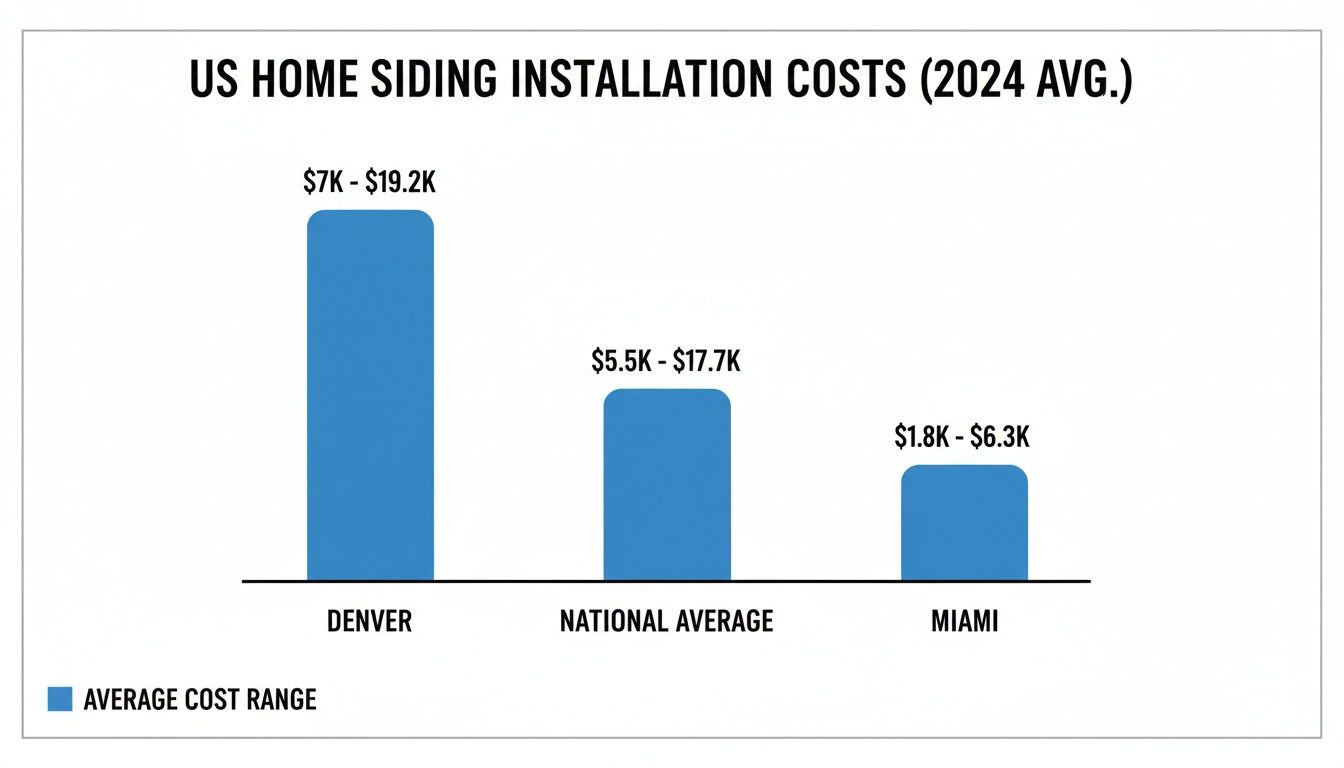
This chart shows exactly why getting a local estimate is so important. A siding job in Denver can cost more than double what it does in Miami.
Cost Scenario 2: The 2,200 sq. ft. Two-Story Home
Once you add a second story, things get a bit more complex. The project now requires scaffolding, more safety precautions, and more labor hours to get materials up high.
- Vinyl Siding: For a 2,200 sq. ft. two-story home, the estimated cost for vinyl typically lands between $8,800 and $19,800.
- Fiber Cement Siding: Choosing fiber cement for the same house would likely put the project in the $15,400 to $30,800 range.
In a place like Upstate South Carolina, where we deal with humidity and heavy storms, fiber cement is an incredibly popular choice. Its long-term performance—we're talking a 50+ year lifespan—and impressive ROI make it a smart investment for many homeowners.
Cost Scenario 3: The 3,000 sq. ft. Custom Home
For larger, more intricate homes, the scope of the project expands quite a bit, which impacts both material and labor costs.
A larger home doesn't just need more siding. It needs more trim, more soffit, and more detailed work around things like gables, dormers, and bay windows. All that intricacy is a key factor in the final price.
- Vinyl Siding: On a 3,000 sq. ft. home, vinyl siding costs will probably range from $12,000 to $27,000.
- Fiber Cement Siding: The same project with fiber cement could start at $21,000 and go up to $42,000 or even higher, especially if you opt for custom colors or high-end finishes.
When you're planning a project this significant, it's wise to understand the landscape of local home improvement contractors and how to find a reliable partner.
These examples should give you a solid foundation for your budget. You can also explore more home exterior renovation ideas to see how new siding can fit into a complete vision for your property.
Common Questions About Siding Replacement Costs
Jumping into a siding replacement project always stirs up a lot of questions, especially about the budget. While our siding cost calculator is a great way to get a quick feel for the numbers, it's totally normal to wonder about the details behind the estimate.
We’ve pulled together the most common questions we hear from homeowners just like you. Our goal is to give you clear, straightforward answers so you can plan your project with confidence.
How Accurate Are Online Siding Calculators?
Think of an online calculator as a fantastic starting point for budgeting. It gives you a solid ballpark figure based on standard inputs like your home's square footage and the material you're interested in. This is incredibly helpful for understanding the general price range you can expect.
However, a calculator can’t see what we can. It doesn’t know about hidden wall rot, tricky architectural features, or specific challenges on your property that might need extra attention. Your calculator estimate is the first step; a professional on-site inspection is what delivers the final, rock-solid quote. To get pricing that's truly tailored to your home, it's always best to consult with professional siding contractors.
Does New Siding Increase My Home's Value?
Absolutely. Siding replacement consistently ranks as one of the smartest home improvement projects you can do, delivering a huge return on investment. In fact, industry reports show that homeowners often recoup a massive chunk of the cost at resale—sometimes over 80%.
New siding does more than just look good. It dramatically boosts curb appeal, improves energy efficiency, and sends a powerful signal to potential buyers that a home is well-cared-for. It's an investment that pays you back, both in enjoyment now and at the closing table later.
Should I Budget for Potential Hidden Costs?
It's always a good idea to set aside a little extra, just in case. We recommend a contingency fund of around 10% of the total project cost. While any trustworthy contractor will give you an all-inclusive quote, surprises can pop up, especially in older homes.
The most common curveball is finding rot or pest damage on the wall sheathing after we've removed the old siding. A seasoned pro can often spot high-risk areas during the inspection, but it’s best to be prepared for those necessary repairs that ensure your new siding has a solid foundation for decades to come.
How Long Does a Siding Replacement Take?
For an average-sized home here in the Upstate SC area, a professional siding replacement usually takes about one to two weeks. But that timeline can shift based on a few key things:
- Home Size and Complexity: Bigger homes or houses with lots of gables, angles, and intricate details will naturally take a bit more time.
- Material Choice: Some materials, like fiber cement, require more precision and a few extra steps during installation compared to vinyl.
- Weather Conditions: You can’t control Mother Nature. Heavy rain or extreme temperatures can cause short, unavoidable delays.
A good contractor will walk you through a clear project schedule from day one. You’ll know the plan for each phase—from tear-off and prep to installation and final cleanup—so there are no surprises.
Ready to move from a ballpark number to a precise, no-obligation quote? The team at Atomic Exteriors is here to provide a detailed on-site assessment and help you choose the perfect siding for your home. Get your free estimate today!