.png)

The Best Gutter Guards for Pine Needles A Complete Guide
When it comes to protecting your home from pine needles, there’s a clear winner: high-quality micro-mesh systems. Their fine, durable screens are specifically designed to block those slender needles that wiggle through the larger openings on other guards. Hands down, they are the most effective long-term solution.
Why Pine Needles Clog Gutters So Effectively
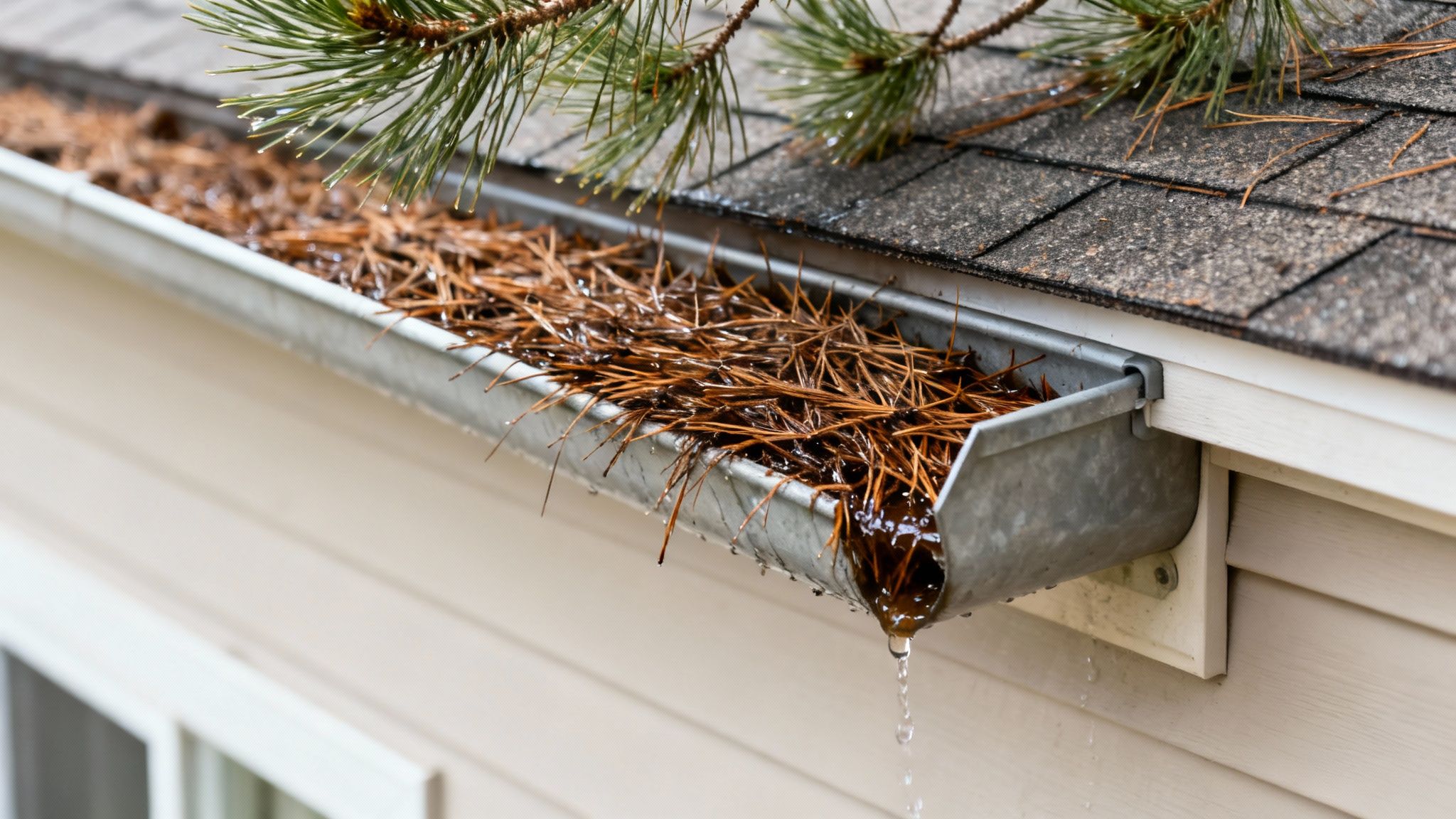
If you have pine trees on your property, you know the struggle is real. They're relentless. Unlike oak or maple leaves that drop seasonally, pines shed their needles all year long, creating a constant threat to your gutter system. This isn't just a small annoyance; it's a legitimate risk to your home.
Pine needles are uniquely built to create stubborn, dense clogs that most standard gutter guards just can’t handle. Their slim shape lets them slip right through screens and grates with bigger holes. Once they’re in, they don’t just pile up—they interlock.
The Anatomy of a Pine Needle Clog
A few things make these needles especially destructive. They have a waxy outer layer, called a cuticle, which helps them shed water and resist rot. That same coating lets them slide past each other and weave together into a tight, dense mat.
When mixed with a little rain and some other small debris, they form what is essentially a dam inside your gutters. This blockage stops water from flowing to the downspouts, forcing it to spill right over the sides.
A single mature pine tree can drop tens of thousands of needles each year. For homes here in Upstate South Carolina surrounded by pine groves, that translates into a perpetual battle against gutter clogs and potential water damage.
From Clogged Gutters to Costly Home Repairs
The consequences of these blockages are serious and can spread quickly. When water overflows, it can damage your home’s most critical parts. Without a proper defense, you’re risking:
- Foundation Damage: Water pooling around the base of your home can lead to cracks and serious structural issues.
- Siding and Fascia Rot: Constant moisture will rot wood trim and compromise your siding.
- Basement Flooding: That overflow soaks the ground and can easily seep into basements or crawl spaces.
- Landscape Erosion: Uncontrolled runoff can wash away topsoil and destroy your landscaping.
Proactive maintenance definitely helps—things like the comprehensive fall cleanups that pay off for the rainy season make a difference, but they don't solve the core problem. The relentless nature of pine needles means cleaning the gutters by hand becomes a frequent, risky chore.
For anyone who wants a more permanent fix than learning how to clean gutters safely multiple times a year, finding the right gutter guard isn't a luxury—it’s a necessity. This guide will show you exactly which systems stand up to the pine needle test.
A Look at Different Gutter Guard Technologies
Not all gutter guards are created equal, especially when your biggest enemy is the relentless downpour of pine needles. To make the right call, you need to understand the basic idea behind each major type of gutter protection. How they’re designed determines everything about how they handle water and, more importantly, how they fend off debris.
The real challenge is simple: let rainwater in, but keep solids out. Every technology tackles this differently. Some are just a basic strainer, while others get clever with physics like surface tension. Knowing these differences is the first step to finding a real, long-term solution for those pesky pine needles.
Micro-Mesh Gutter Guards: The Fine Filter
Let's start with what most pros consider the gold standard for pine needle defense: micro-mesh guards. Think of them as an incredibly fine screen, usually made from stainless steel, stretched tight over a tough frame that sits right on top of your gutters.
The holes in the mesh are so tiny—often smaller than the tip of a pin—that they let rainwater pour through while blocking just about everything else. We’re talking pine needles, shingle grit, and even pollen. Because nothing but water gets into the gutter, the system stays clean and flows freely, just like it's supposed to.
Reverse Curve Gutter Guards: The Surface Tension Method
Reverse curve guards, sometimes called surface tension guards, play by a completely different set of rules. These are solid-hooded covers that stick out from your roofline, then curve back over and into the gutter.
The idea is that rainwater clings to the curved surface and follows it into a narrow slot, while leaves and pine needles are supposed to slide right off the edge. It’s a neat concept, and it can work well for big leaves. But these guards can get overwhelmed in a heavy downpour, and smaller, stubborn pine needles often find a way to slip right through the opening.
Brush and Foam Gutter Guards: The Insert Solution
Brush and foam guards are the simple, DIY-friendly options you’ll find at the big-box stores. You just stuff them directly into the gutter channel.
- Brush Guards: These look like giant, bristly pipe cleaners. The theory is that the bristles catch leaves and sticks while water flows around them. The reality? Pine needles get hopelessly tangled in the bristles, creating a new type of clog that’s often even tougher to clean out than an empty gutter.
- Foam Inserts: These are porous foam blocks designed to fill the gutter. Water is supposed to soak through the foam while debris sits on top. Unfortunately, tiny debris like pine needles and seeds quickly plugs up the foam's pores. Before you know it, you have a saturated, heavy dam that blocks water completely.
Pine needles are a serious headache for homeowners. A survey from This Old House found that 31% of homeowners see pine needles as a top debris problem, which shows just how big the challenge is in pine-heavy areas like Upstate South Carolina. You can see more from that homeowner survey over on ThisOldHouse.com.
In the end, while brush and foam guards are cheap, they often create more problems than they solve when you're up against pine needles. Their design accidentally traps the very thing you're trying to block. For a lasting solution that actually works, you need a system engineered to keep needles out entirely, which is why exploring professional gutter systems and protection is almost always the most effective way to go.
When you're dealing with a yard full of pine trees, the performance gap between different gutter guard technologies becomes crystal clear. A system that works wonders for big, flat maple leaves might completely surrender to the relentless, slender assault of pine needles.
To find the best gutter guards for the job, we have to compare them based on what really matters in the Upstate: how well they block needles, how often you’ll have to get the ladder out, and whether they’ll last.
This breakdown shows how common gutter guards stack up against the unique challenge pine trees present.
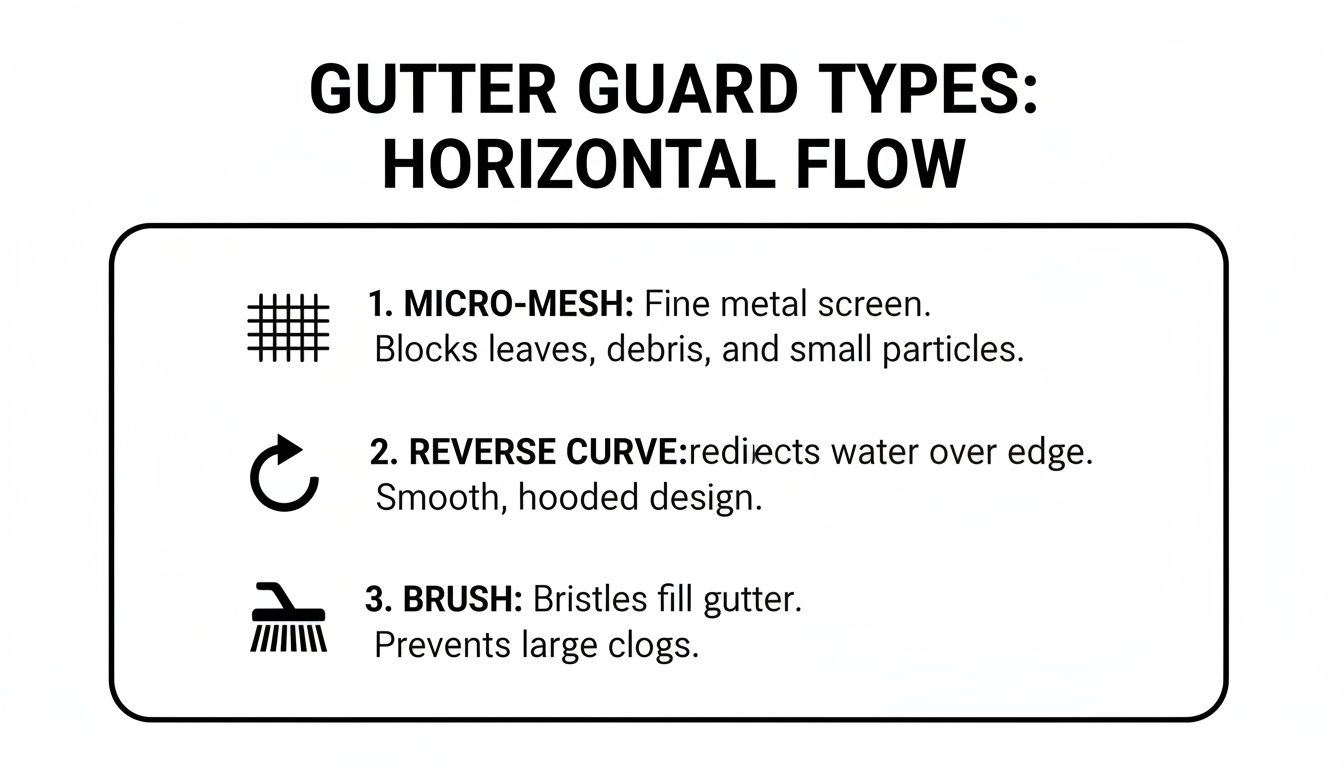
As you can see, each one takes a fundamentally different approach. And for pine needles, the results vary wildly.
Micro-Mesh Guards: The Premier Defense
Micro-mesh guards consistently come out on top for homes with pine trees, and the reason is simple: their design is a direct counter to the needle's size and shape. The screen is made from stainless steel with openings so tiny that even the thinnest needles can't slip through.
Water flows right through the mesh, while all the debris—needles, shingle grit, and seeds—stays on the surface. When it rains, much of that debris just washes right off. Whatever is left dries out in the sun and gets blown away by the next breeze.
- Blocking Efficiency: Nearly 100%. A quality micro-mesh system with a sturdy aluminum frame will block virtually all pine needles from ever getting into your gutter channel. This prevents those dense, interlocking mats of needles from forming in the first place.
- Maintenance Frequency: Very low. Instead of scooping out handfuls of wet, decaying needles from your gutters multiple times a year, you might only need to give the surface of the guards a light brushing every few years. It’s a game-changer for reducing the time, effort, and risk of climbing a ladder.
- Durability and Value: High-end systems are built to last for decades. They resist rust, warping, and pests. While the initial investment is higher, the near-elimination of maintenance and superior protection against water damage deliver incredible long-term value.
For homes across Upstate South Carolina, where dense pine forests are a common sight, a micro-mesh system is less of a luxury and more of an essential tool for protecting your home. It’s the only technology truly designed to win the year-round battle against pine needle clogs.
Reverse Curve Guards: A Solid Contender with Caveats
Reverse curve guards, also known as surface tension guards, use a clever design based on how water behaves. They guide rainwater around a curved hood and into the gutter, while larger debris is supposed to slide right off the edge.
This design actually works quite well for big, bulky leaves and twigs. When it comes to pine needles, though, the performance is a bit more mixed.
The weak point is the small opening that lets water in. During a heavy downpour, a rush of water can carry pine needles right into that slot, completely bypassing the system's design. Needles can also get stuck right at the edge of the opening, creating a tiny dam that blocks water flow.
- Blocking Efficiency: Good, but not perfect. They’ll stop a significant amount of debris, but you have to accept that some needles will find their way into the gutter, especially during a gully washer or if the guards aren't installed at the perfect pitch.
- Maintenance Frequency: Moderate. You won't be cleaning inside your gutters nearly as often, but the opening itself and the underside of the hood can collect debris and will need periodic cleaning to keep working correctly.
- Durability and Value: Quality reverse curve systems are durable and can last for many years. They offer a good balance of performance and cost for homes with a mix of different trees and a moderate number of pines. It's also worth thinking about how guards pair with gutter styles; our guide on seamless gutters vs regular gutters can give you the full picture.
Why Other Gutter Guards Fail the Pine Needle Test
While micro-mesh and reverse curve are the main contenders, other common gutter guards are notoriously bad at handling pine needles. Understanding why they fail is key to avoiding a costly mistake.
Brush Gutter Guards
These look like giant pipe cleaners that you stuff into your gutters. The idea is that the bristles catch debris while letting water flow through.
- The Reality: The bristles are a perfect trap for pine needles. Instead of blocking them, they grab onto needles and hold them tight, creating a bristly, clogged dam that’s often even harder to clean than an empty gutter. The needles weave themselves deep into the bristles, making removal a truly miserable job.
Foam Gutter Guards
These are triangular blocks of porous foam that sit inside the gutter. They’re meant to let water soak through while debris stays on top.
- The Reality: The tiny pores in the foam get clogged almost instantly by pine needles, seeds, and shingle grit. Once the foam is saturated and packed with debris, it blocks water completely, turning your gutter into a stagnant swamp. They also tend to break down in the sun, creating even more gunk in your system.
Basic Screen and Perforated Guards
These are the simplest guards you can find—usually just cheap metal or plastic screens with large holes. They’re inexpensive and available everywhere.
- The Reality: The holes on these guards are way too big to stop pine needles. Needles either fall right through or get stuck halfway, creating a porcupine-like effect that just catches more leaves and twigs. They offer almost no real protection and can sometimes make clogs even worse.
Gutter Guard Performance Against Pine Needles
To put it all in perspective, here’s a quick side-by-side comparison. This table clearly shows how each type of gutter guard stacks up when faced with the specific challenge of pine needles.
| Micro-Mesh | Excellent (99%+) | Low (brush off every few years) | $20 - $30+ | Homes with heavy pine needle fall where you want a "set it and forget it" solution. |
| Reverse Curve | Good (~70%) | Moderate (annual check-up) | $15 - $22 | Homes with a mix of trees and moderate pine needle fall. |
| Brush Inserts | Very Poor (<20%) | Very High (seasonal cleaning) | $3 - $5 | Not recommended for pine trees. Needles get deeply embedded and are hard to remove. |
| Foam Inserts | Very Poor (<10%) | Very High (seasonal cleaning) | $2 - $4 | Not recommended for any debris. Pores clog quickly and the material degrades in the sun. |
| Basic Screen | Poor (~30%) | High (frequent cleaning) | $1 - $3 | Homes with only large-leaf trees; completely ineffective against pine needles. |
As you can see, the choice becomes pretty clear. For homeowners who are serious about solving their pine needle problem for good, the options really narrow down to micro-mesh or, in some specific situations, a reverse curve system. The other styles just aren't built to handle such small, persistent debris and often lead to wasted money and continued frustration.
Looking at the Real Cost and Long-Term Payoff
It’s easy to get tunnel vision and only focus on the initial price tag when choosing gutter guards for pine needles. That’s a classic mistake. The smart money is on looking at the total cost of ownership and what you get back over the long haul. Trust me, today's cheap fix often becomes tomorrow's most expensive problem.
A solid investment in your home's exterior protection pays for itself time and time again. It’s not just about preventing clogs; it's about protecting your home's value and dodging those eye-watering repair bills that can come out of nowhere.
Breaking Down the Upfront Installation Costs
The initial bill to get gutter guards installed can swing wildly depending on the system you pick. A top-tier micro-mesh guard will cost more upfront than a DIY foam insert you can grab at the hardware store, but that first number is far from the whole story.
Let's run some realistic numbers for an average American home with around 200 linear feet of gutters:
- Foam or Brush Guards (DIY): At $2 to $5 per foot, you’re looking at around $400 to $1,000. It looks great on paper, but this is just the beginning of your expenses.
- Reverse Curve Guards (Professional): These systems usually land between $15 to $22 per foot, putting your total somewhere in the $3,000 to $4,400 range. It's a mid-level investment with decent, though not perfect, performance.
- Micro-Mesh Guards (Professional): As the best solution on the market, you can expect to pay $20 to $30+ per foot. That brings the total investment for a quality system to $4,000 to $6,000+.
The micro-mesh price might cause a bit of sticker shock, but it’s critical to see past that number and understand what you're actually buying. For a better sense of how this fits into a bigger project, check out our guide on the cost of seamless gutters.
The Hidden Costs of Going Cheap
The real financial hit from cheap gutter guards comes from the constant maintenance and their laughably short lifespan. Foam and brush guards practically surrender the moment they meet a pine needle, kicking off a cycle of recurring costs that stack up fast.
Think about the labor. A professional gutter cleaning runs $150 to $350 a pop. If your "bargain" guards force you to call someone out twice a year, you’re suddenly spending up to $700 annually. Over just five years, that’s an extra $3,500 poured into a system that isn't doing its job.
A low-quality gutter guard isn't a solution; it's a subscription to a problem. The money you save upfront gets eaten up by cleaning fees and the eventual cost of ripping it all out and starting over.
And that’s not all. These systems often need to be completely replaced every two or three years. The initial $1,000 you thought you "saved" is long gone, and you’re right back where you started—only now you’re out thousands more in maintenance fees.
Factoring in the Cost of Water Damage
Here’s the biggest factor in your long-term return: preventing catastrophic water damage. A single, nasty clog from pine needles can unleash a torrent of problems, leading to repairs that cost thousands upon thousands of dollars.
This is what you're really protecting your home from:
- Foundation Repair: When water pools at the base of your home, it can cause cracks and shifting. Fixing that can cost anywhere from $5,000 to $15,000, sometimes even more.
- Siding and Fascia Replacement: Rotting wood and warped siding isn’t just ugly; it’s expensive. You could be looking at a $2,000 to $10,000 bill depending on how bad it gets.
- Basement Flooding: The bill for cleaning up a flooded basement can easily top $10,000 once you account for water extraction, mold remediation, and replacing damaged property.
When you put a one-time $5,000 investment in a permanent micro-mesh solution up against a potential $15,000 foundation repair, the value becomes crystal clear. A high-performance system isn't an expense; it’s an insurance policy against water damage. Backed by professional installation and a solid warranty, it secures your investment and protects your home for decades.
How to Choose the Right Guard for Your Home

Picking the best gutter guards for pine needles isn’t about finding one “perfect” product. It’s about matching the right design to the real-world challenges your home faces every day. Things like the number of pine trees towering over your roof, its slope, and our local weather patterns all have a say in the matter.
This goes way beyond a simple pros-and-cons list. It’s a practical assessment of your home’s unique environment. When you know exactly what you’re up against, you can choose a system that gives you lasting protection and true peace of mind, finally ending that constant cycle of clogs and cleaning.
Assess Your Property's Pine Needle Density
First things first: how bad is the pine needle problem? The sheer volume of needles your gutters have to deal with is the most important factor. A home with one distant pine tree has completely different needs than a house buried under a thick canopy.
Take a walk around your yard and see which of these scenarios fits best:
- High-Density Scenario: Your home is surrounded by mature pines. Needles blanket your roof, yard, and driveway pretty much year-round. Clogged gutters are a constant headache after every storm.
- Moderate-Density Scenario: You have a mix of trees, including a few pines. Needles are part of the problem, but you also get a lot of leaves, twigs, and maybe some gumballs or acorns.
- Low-Density Scenario: There are one or two pine trees near the edge of your property. A few needles find their way into the gutters, but they aren't the main culprit causing clogs.
Just figuring this out will point you toward the right category of gutter protection. It’ll keep you from overspending on a system you don’t need—or worse, under-investing in one that’s guaranteed to fail.
For homes squarely in the high-density category, a premium stainless steel micro-mesh system is the only reliable, long-term answer. It blocks nearly 100% of pine needles, making it the undisputed champ for properties under a heavy, year-round assault.
Consider Your Roof's Pitch and Local Climate
It’s not just about the debris. Two other factors have a huge impact on how well your gutter guards will perform: your roof's pitch and the intensity of our local downpours.
A steep roof uses gravity to its advantage, helping rainwater wash needles and leaves right off the surface of the guards. On the flip side, a low-pitch or nearly flat roof lets debris just sit there and pile up, which means you need a guard that doesn't rely on a strong water flow to stay clean.
Here in Upstate South Carolina, we’re known for sudden, torrential rainstorms. That adds another wrinkle. During those heavy downpours, your gutter system has to channel a massive amount of water in a very short time. If your guards can’t keep up, water will just pour over the sides, which defeats the whole purpose of having gutters in the first place. Water intake capacity is a make-or-break feature around here.
Matching the Guard to Your Home's Needs
Now that you've sized up your property, you can make a clear, confident decision. This is where we connect the dots and turn the technical details into a practical choice for your specific situation.
Clear Recommendation Scenarios
- For the Pine-Dominated Property (High Density): Your only real choice is a stainless steel micro-mesh guard. Its incredible filtration is non-negotiable when you’re facing a constant barrage of needles. This is the ultimate "set it and forget it" solution for homes with extreme pine debris.
- For the Mixed-Foliage Yard (Moderate Density): A high-quality reverse curve guard can offer a great balance of performance and value. It does a good job with larger leaves while still managing a fair amount of pine needles. But if your budget has room, micro-mesh is still the superior choice for total protection.
- For Minimal Pine Debris (Low Density): While a reverse curve system works just fine here, a durable micro-mesh system is still a smart long-term investment. It protects against everything—not just the occasional pine needle—which is a key part of smart home care. To see how it all fits together, check out our exterior home maintenance checklist.
Common Questions About Gutter Guards for Pine Needles
Even with all the comparisons laid out, some real-world questions always pop up. Getting straight answers is the best way to feel good about your choice, so let's tackle the questions we hear most often from homeowners fighting the pine needle battle.
Can Any Gutter Guard Completely Eliminate Gutter Cleaning?
In a word, no. There’s no such thing as a truly zero-maintenance gutter guard, especially here in Upstate South Carolina where pine trees are a fact of life. The real goal is to stop clogs from ever forming inside your gutter channel, and that's where the best systems shine.
A high-quality micro-mesh guard gets you as close to "set it and forget it" as possible. Instead of climbing a ladder for messy cleanouts multiple times a year, you might just need to brush off the surface every few years. Cheaper guards, on the other hand, like foam or brushes, often become the clog themselves, sometimes creating more work than having no guards at all.
Will Gutter Guards Affect My Roof Warranty?
This is a huge one, and the answer comes down to how the system is installed. Some gutter guards are designed to slide under the first row of your shingles, which is a surefire way to void your roof's warranty. Shingle manufacturers will argue that lifting those shingles compromised the watertight seal.
It's absolutely critical to pick a system that mounts directly to the gutter itself, leaving your roofing materials completely untouched. Modern, professional-grade systems are engineered specifically to be warranty-safe, protecting both your gutters and your roof coverage.
Always, always confirm with your installer that their method won't mess with your shingles. It’s a simple step that protects your home and your investment. And while pine needles are the main topic, remember that guards also keep out other debris like shingle grit. The tiny particles from aging shingles can create sludge, and you can learn more about understanding granule loss on shingles and its impact on your whole roofing system.
Is a Micro-Mesh Gutter Guard Worth the High Cost?
For any home surrounded by pine trees, a premium stainless steel micro-mesh system is almost always worth the investment. Yes, the upfront cost is higher, but the long-term value in preventing pine needle clogs is simply unmatched.
Think of it in terms of total cost of ownership. These systems are the most effective, demand the least maintenance, and hold up the best against rust and warping. When you weigh the one-time cost of a permanent fix against the recurring fees for professional gutter cleanings—or the catastrophic cost of repairing water damage to your foundation or siding—the math becomes pretty clear.
A dependable micro-mesh guard buys you lasting peace of mind and saves you a ton of money over the life of your home. It’s the most effective way to solve the pine needle problem for good.
Ready to stop worrying about pine needles for good? The team at Atomic Exteriors installs high-performance gutter guard systems designed to handle the toughest debris our local climate throws at them. Protect your home with a proven, long-term solution. Schedule your free, no-obligation estimate today by visiting us at https://atomicexteriors.com.