.png)
A Homeowner's Guide to Casement Windows Sizes
Walk into any home improvement store, and you might see a section labeled "standard size" windows. This can be a little misleading. In the world of windows, “standard” doesn’t mean one-size-fits-all.
Understanding Standard Casement Window Sizes
Think of it less like a fixed measurement and more like a pre-set menu at a restaurant. Manufacturers have a range of common dimensions they can produce efficiently and cost-effectively, typically falling between 14 to 36 inches in width and 24 to 72 inches in height.
This "menu" of sizes is based on decades of homebuilding trends and common architectural needs. Choosing a standard size often means a quicker turnaround and a lower price tag compared to a fully custom window, which is great for many homeowners. It’s the difference between ordering a small, medium, or large coffee versus specifying the exact fluid ounces you want.
Common Size Ranges for Casement Styles
Of course, the "standard" range shifts depending on the type of casement window you’re looking at. Each style is designed for a different purpose, which influences its typical dimensions.
- Single Casement Windows: This is your classic design—a single sash that cranks outward. They are almost always taller than they are wide. To keep the hinges from being over-stressed by the weight of the sash, their width is usually kept under 3 feet.
- Double Casement Windows: Also known as French casements, these are a homeowner favorite. Two sashes meet in the middle and swing open, creating a gorgeous, completely unobstructed view. Because the weight is distributed between two sashes, they can span much wider openings, making them perfect for living rooms or above a kitchen sink.
- Picture Casement Windows: This is the best of both worlds—a large, fixed "picture" window flanked by two smaller, operable casement windows. You get that huge, uninterrupted view and the ability to let in a cross-breeze.
To see how other window types handle sizing, you can check out these common Velux window sizes for comparison.
Choosing the right size isn't just about how it looks; it's about function and safety. For instance, a bedroom window must meet local egress codes to ensure a safe exit in an emergency. Casement windows are a fantastic choice here because the entire sash swings clear, maximizing the open space.
Below is a quick reference chart to help you visualize the most common dimensions for these different styles.
Common Casement Window Size Ranges
This quick reference chart shows typical dimensions for common casement window configurations, helping you visualize the options available for different spaces in your home.
| Single Casement | 14" – 36" | 24" – 72" | Bathrooms, kitchens, bedrooms |
| Double Casement | 36" – 72" | 24" – 60" | Living rooms, primary bedrooms |
| Picture with Flankers | 72" – 108" | 36" – 72" | Great rooms, dining areas |
Ultimately, getting a handle on these common sizes is the first step toward a successful window replacement project. It gives you the power to make smart decisions that perfectly match your home’s architecture, your budget, and your lifestyle.
And if you're still weighing your options, our guide to the best replacement windows for homes is a great place to see how casements stack up against other popular styles.
How to Get Your Casement Window Measurements Spot-On
You’ve heard the old carpenter’s rule: “measure twice, order once.” When it comes to windows, that advice is gold. Getting your measurements right is the absolute foundation of a successful installation—it’s what prevents drafts, ensures your windows open smoothly, and gives you that flawless, built-in look.
First things first, you need to know what you’re measuring for. Are you putting in a replacement window, or is this for new construction?
- Replacement Windows: These are designed to slide neatly into an existing window frame. You’ll be measuring the inside of the current frame—from jamb to jamb (side to side) and from the sill up to the head (bottom to top).
- New Construction Windows: This is a bigger job where the entire frame is removed, exposing the raw, wooden rough opening. Here, you’d measure from stud to stud.
Since most homeowners are upgrading, we'll focus on the measurements for a replacement window.
The Pro’s Three-Point Measurement Trick
To get a truly accurate size, you can’t just measure once and call it a day. Houses settle over time, and what looks perfectly square to the eye might be slightly off. This is especially true for older homes in our area. The three-point technique accounts for any of those little imperfections.
Measure the Width: Grab your tape measure and place it inside the window frame. Measure the distance from the left jamb to the right jamb at three spots: the top, the middle, and the bottom. Write all three down, but the smallest of the three is your official width. This ensures the new window will fit, even at its tightest point.
Measure the Height: Now do the same thing vertically. Measure from the head (the top of the frame) down to the sill (the very bottom where the window rests). Take this measurement on the left side, in the center, and on the right side. Just like before, record the smallest of the three measurements.
Check for Square: This is the final check that separates the pros from the amateurs. Measure the opening diagonally from the top-left corner to the bottom-right. Then, measure from the top-right to the bottom-left. If the numbers are the same, congratulations—your opening is perfectly square. If they’re off by more than a quarter-inch, the opening is out of square and might need some professional finessing to get a perfect fit.
This simple process gives you a clear picture of your window dimensions, starting with the space you have and factoring in the type of window you need.
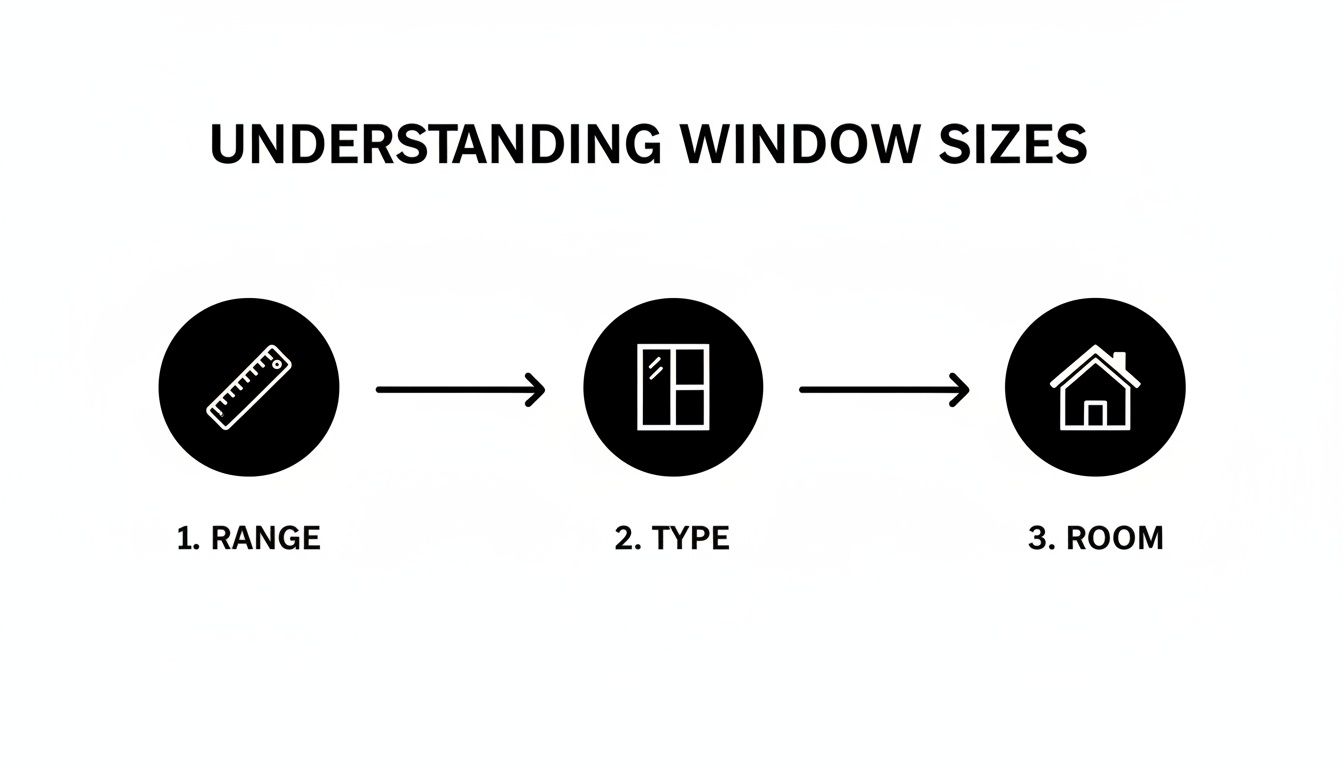
As this guide shows, figuring out the right size is about more than just the numbers—it’s also about matching the window type to how you use the room.
Pro Tip: When you place your window order, always give the manufacturer your smallest width and height measurements. They already know to deduct about a quarter to a half-inch from those numbers. That tiny gap leaves just enough room for shims and insulation, creating that snug, airtight seal you want.
Taking the time to measure carefully is one of the most important steps in any successful home window replacement project. With these precise numbers in hand, you’re ready to choose windows that not only look fantastic but will perform beautifully for years to come.
Choosing Between Standard and Custom Window Sizes
Once you have your measurements, you’re at a crossroads that will shape your home’s look, your project timeline, and your budget. Should you go with a standard size or opt for custom? This isn't just about the price tag; it's about finding the absolute best solution for your home's unique character.
Think of standard windows as the "off-the-rack" option from a department store. Manufacturers produce them in bulk to fit common dimensions, which makes them more affordable and quicker to get. If your home’s openings happen to align with these common sizes, a standard casement window can be a smart, efficient choice.
But let's be realistic—most homes, especially older ones here in the Upstate, weren't built with modern, uniform openings. This is where custom casement windows go from being a luxury to a necessity.
The Unmatched Value of a Perfect Fit
A custom window is built from the ground up to fit your opening perfectly, down to a fraction of an inch. Yes, this means a higher initial investment and a bit more of a wait, but the long-term rewards are huge. You avoid those awkward gaps that have to be stuffed with excess foam and shims, a dead giveaway of a sloppy installation that compromises insulation.
A perfect-fit installation means your casement window seals flawlessly against the frame. This maximizes its natural energy efficiency, eliminating the tiny drafts that can drive up utility bills over time. It’s an investment in your home’s comfort and long-term value.
Ultimately, a custom window looks like it was always meant to be there, not like a forced retrofit. To get a better handle on how these costs break down, you can play around with our detailed window replacement cost estimator and see how different choices impact the bottom line.
Why Casement Windows Are So Popular Right Now
Homeowners are getting smarter about performance, and casement windows are leading the pack. The U.S. windows market was valued at USD 12.32 billion in 2022, and the casement segment is its fastest-growing star, expanding at a 4.1% CAGR. Why? People love their incredible wind resistance and the fully insulated seal they create when closed, which blows traditional sash windows out of the water when it comes to stopping air leakage.
So, how do you make the final call? It boils down to a few key questions:
- Architectural Integrity: Does your home have unique, non-standard openings? Custom is the only way to go to preserve its original charm.
- Budget and Timeline: If your project is on a tight budget or schedule with standard-sized openings, a stock window might be the most practical path.
- Performance Goals: If your top priority is squeezing every bit of energy savings out of your home with a flawless seal, the investment in a custom fit pays for itself.
Making this choice with care ensures your new windows don't just look great—they'll deliver the comfort and performance you expect for decades.
How Window Size Impacts Energy Efficiency
The size of your casement window is much more than an aesthetic choice—it’s a huge factor in your home's energy performance. Think of a window as a thermal gate. The larger that gate, the more potential there is for heat to pass through, which is why understanding the link between size and efficiency is key to managing your home's comfort and utility bills.
It all boils down to the glass-to-frame ratio. A smaller casement window has a higher proportion of frame material compared to its glass area. On the flip side, a large picture casement has a massive glass surface with relatively little frame. Since glass and frame materials conduct heat differently, this ratio directly impacts the window's overall energy ratings.
Decoding U-Factor And Solar Heat Gain
Two key numbers tell you almost everything you need to know about a window’s performance: U-factor and Solar Heat Gain Coefficient (SHGC).
- U-Factor: This measures how well a window prevents heat from escaping your home. The lower the number, the better the insulation. Larger windows with high-performance glass can often achieve incredible U-factors.
- Solar Heat Gain Coefficient (SHGC): This tells you how much of the sun's heat the window lets in. A low SHGC is non-negotiable for our hot South Carolina summers, as it blocks that intense solar heat from warming up your rooms.
A large casement window with a high SHGC can act like a magnifying glass, baking your living room in the afternoon sun and forcing your AC to work overtime. This is why choosing the right glass package—like double or triple-pane with Low-E coatings—is critical for bigger windows. These advanced technologies are designed to block heat without sacrificing that beautiful natural light.
For an extra layer of defense, especially with larger windows facing the sun, you might also consider external solutions like solar window screens.
The Power Of A Perfect Seal
Beyond the glass, the signature airtight seal of a casement window is its greatest energy-saving superpower. When you crank it shut, the sash presses firmly and evenly against the frame, creating a seal that’s far tighter than what you’ll find on most sliding or double-hung windows.
A custom-sized casement window maximizes this benefit by ensuring there are no gaps between the window unit and your home’s rough opening. This perfect fit eliminates drafts and guarantees the window performs exactly as it was designed to.
For homeowners and property managers, this means custom-sized, Energy Star-certified windows can lower energy bills by up to 20-30% compared to old, single-pane setups. It’s a smart investment that pays for itself over time.
By carefully considering the size and features of your new casement windows, you are taking direct control over your home's energy consumption. To learn more about how this works, read our complete guide on the benefits of energy-efficient windows.
Meeting Building Codes with the Right Window Size
When you're picking out new casement windows, it's about more than just looks and energy ratings. You also have to meet local building codes. These rules aren't just red tape—they're critical safety standards designed to protect your family, and one of the most important is the egress requirement.
Think of an egress window as a built-in emergency exit. Building codes demand that any room meant for sleeping, like a bedroom, must have at least one window big enough for someone to climb out of during a fire or other emergency. This is an absolute must-have, especially for bedrooms on the ground floor or in basements where other escape routes are scarce.
Understanding Egress Requirements
The technical jargon in building codes can be a bit much, but the core requirements for egress are actually pretty straightforward. Most local codes are based on the International Residential Code (IRC), which sets minimum dimensions for the clear opening—that’s the actual open space you can climb through.
An egress window has to check these four boxes:
- A minimum clear opening width of 20 inches.
- A minimum clear opening height of 24 inches.
- A minimum total clear opening area of 5.7 square feet (or 5.0 square feet for ground-floor windows).
- A maximum sill height of 44 inches from the finished floor.
That last point is really important. The bottom of the window opening can't be so high off the ground that it’s a struggle to get out, especially in a panic.
Casement windows are often the perfect solution for meeting these strict size requirements, particularly in smaller rooms. Because the entire sash cranks outward and away from the opening, they give you a 100% clear escape route, unlike a double-hung window where the sashes always block half the space.
Why Casement Windows Excel at Safety
Imagine trying to squeeze through a window where the top or bottom sash is always in the way. It dramatically shrinks your usable escape area. A casement window, on the other hand, swings open just like a door, maximizing every single inch of the opening.
This unique design means a relatively small casement window can often meet egress codes where a much larger double-hung or sliding window would fail. For homeowners here in Upstate South Carolina, this is a massive advantage when remodeling older homes that often have smaller, non-standard window openings. It ensures your project isn't just beautiful and efficient, but fully compliant and, most importantly, safe for your family.
Exploring Your Casement Window Options
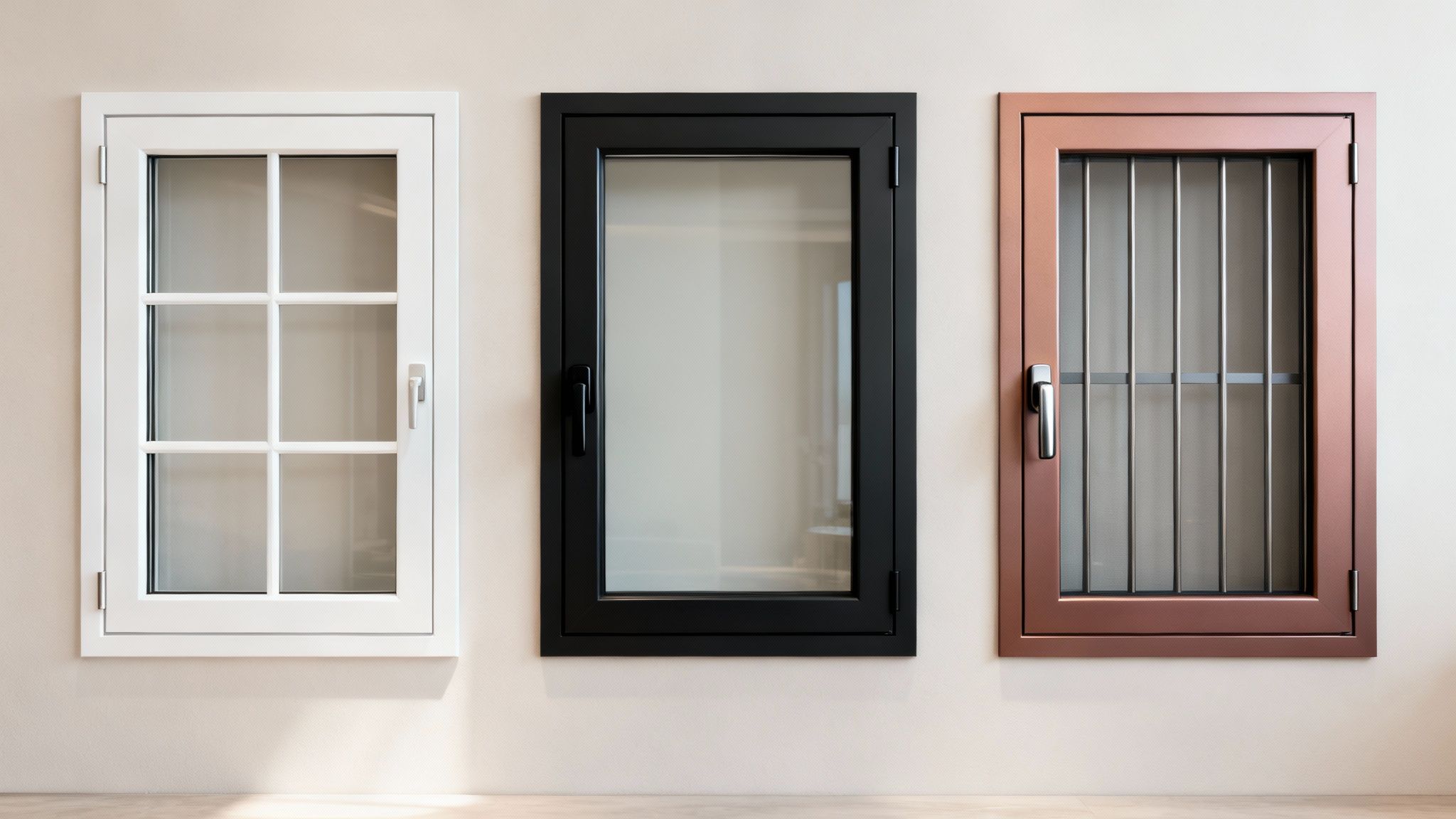
Getting the right casement window sizes is the technical starting point, but the real fun begins when you start exploring the design possibilities. This is your chance to turn a functional window into a stunning architectural feature that genuinely boosts your home’s character and curb appeal.
Once the dimensions are locked in, you can personalize just about every other detail. The right choices bring your vision to life, making sure the final result looks intentional and like it was always meant to be there.
Customizing Your Window Aesthetics
Your home is a reflection of your personal taste, and windows play a huge role in telling that story. Modern casement windows give you a massive palette to work with, allowing for a truly custom design that complements both the inside and outside of your home.
Here are a few popular ways you can make them your own:
- Grid Patterns: Want to add some classic charm? Colonial or prairie-style grids are perfect for breaking up large panes of glass. They add visual interest that works beautifully with traditional Upstate home styles.
- Hardware Finishes: The crank handle and lock are more than just functional parts—they're accent pieces. You can choose from sleek brushed nickel for a modern vibe, oil-rubbed bronze for rustic warmth, or classic white for a clean, seamless finish.
- Frame Colors: Long gone are the days of being stuck with white or beige. Today’s frame colors—like black, bronze, and even deep greens—can create a bold, contemporary statement that makes your home the talk of the neighborhood.
A professional installation is what protects this investment. It ensures every custom detail looks perfect and performs flawlessly for years. This is why a strong workmanship warranty and reliable customer support are non-negotiable.
The Impact on Home Value and Appeal
These aesthetic choices do more than just look good; they add real, measurable value. In competitive markets, real estate agents have noted that homes with modern, well-chosen casements can sell 5-10% faster. Buyers are drawn to their clean look and the peace of mind that comes with a solid, long-term warranty.
By combining precise casement window sizes with thoughtful design choices, you’re creating a beautiful, efficient, and valuable upgrade. To see the full range of styles we offer, take a look at our complete selection of high-performance replacement windows.
Still Have Questions About Casement Window Sizes?
Of course, you do! This is a big decision, and it’s smart to have all the facts. Here are a few quick answers to the questions we hear most often from homeowners right here in the Upstate.
What Is the Largest a Single Casement Window Can Be?
Most manufacturers will draw the line at around 36 inches wide and 72 inches tall for a single casement window. Any bigger than that, and you start putting serious strain on the hinges and locking hardware. Over time, that extra weight can compromise the window’s airtight seal, which is the last thing you want.
If you’ve got a wider opening to fill, the better solution is usually a double (or French) casement, or even a stunning picture window flanked by two smaller casements.
Are Custom Sized Windows Significantly More Expensive?
It’s true there’s an extra cost for custom sizes, but it’s almost always more affordable than homeowners think.
Plus, that initial investment pays for itself down the road. You get superior energy efficiency from a perfect seal, a flawless look that feels intentional, and a much smoother installation process that doesn't involve tearing apart your home's framing.
Can I Replace a Double Hung Window with a Casement Window?
Absolutely—and it’s one of the most popular upgrades we do. Homeowners are consistently amazed at the difference it makes. Swapping out old, drafty double-hung or slider windows for modern casements instantly improves airflow, opens up your view without a meeting rail in the way, and delivers much better energy savings.
A professional installer can measure your existing opening precisely to make sure the new casement fits like it was always meant to be there.
Ready to find the perfect fit for your home? The team at Atomic Exteriors provides expert guidance and flawless installation for custom-sized casement windows across Upstate South Carolina. Get your free, no-obligation estimate today by visiting https://atomicexteriors.com.