.png)
How to Reduce Utility Bills A Homeowner's Guide
Let's be honest, getting that utility bill in the mail can feel like a gut punch, especially here in Upstate South Carolina where our HVAC systems work overtime in the summer heat and winter chill. It’s easy to feel stuck, thinking the only way out is a massive, bank-breaking renovation.
But that’s not where the journey to lower energy costs begins. It starts with understanding where your money is actually going.
Most of that wasted energy escapes through your home's "building envelope"—the shell that separates your comfortable living space from the outdoors. We're talking about your roof, walls, windows, doors, and foundation. When that envelope has leaks, drafts, or poor insulation, your heater and air conditioner are forced to run constantly just to keep up. That's what's really driving up your bills.
The secret to taking back control is a layered approach. You start with the easy wins, build momentum with some simple maintenance, and then plan for the bigger upgrades that deliver the biggest long-term payoff.
A Three-Pronged Attack on High Energy Bills
The most effective way to shrink your utility bills is to tackle the problem from three angles. You start with no-cost habits, move on to low-cost DIY maintenance, and then strategically plan for larger upgrades that offer the best return on investment.
A great first step that falls squarely in the low-cost maintenance category is to effectively seal your home's ductwork with mastic sealant. Leaky ducts can be a huge, hidden source of energy loss, and sealing them up is a project many homeowners can handle themselves.
This tiered method ensures you start seeing savings right away while you build up to more substantial projects.
"A staggering one in five California households is behind on their energy bills. While rates and policies differ by state, this highlights a nationwide struggle with energy affordability and the urgent need for practical, home-based solutions."
This guide will break down each layer, giving you a clear roadmap to regain control of your energy use. We'll cover everything from simple thermostat tricks to the real-world benefits of upgrading to high-performance windows and insulated siding.
The infographic below gives a great visual overview of what a successful utility-reduction plan looks like.
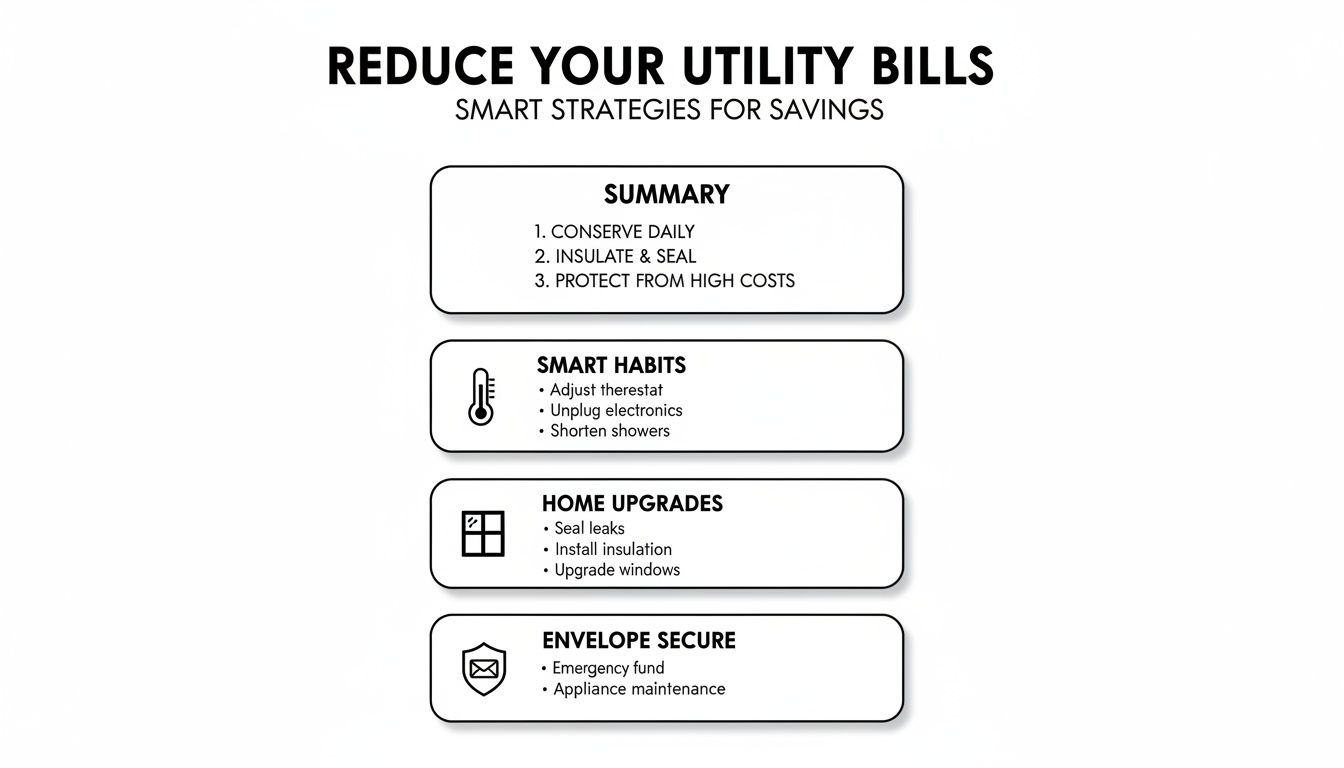
As you can see, it all comes down to combining smart habits with strategic home improvements. By focusing on these areas, you’re not just saving money; you’re creating a more efficient, comfortable home. Our goal is to give you a clear plan tailored to our local climate, helping you make informed decisions that put cash back in your pocket every single month.
At a Glance: How to Reduce Utility Bills
To get a quick sense of where to start, this table outlines some of the most effective strategies. It breaks down the potential savings, what you can expect to invest, and how quickly you can get it done.
| Seal Air Leaks | $100 - $400 | $20 - $200 (DIY) | 1 Weekend |
| Tune Up Your HVAC | $150 - $300 | $100 - $250 (Pro) | 1 - 2 Hours |
| Add Attic Insulation | $200 - $600 | $1,500 - $3,500+ | 1 - 2 Days |
| Upgrade Windows | $150 - $500 | $8,000 - $20,000+ | 1 - 4 Days |
| Install Insulated Siding | $200 - $500 | $10,000 - $25,000+ | 1 - 2 Weeks |
Think of this as your cheat sheet for prioritizing projects. A few hours spent sealing drafts this weekend could save you hundreds by next year, paving the way for bigger, high-impact upgrades down the road.
Smart Habits for Everyday Energy Savings
While big-ticket upgrades like new siding and windows offer incredible long-term returns, the fastest path to a lower utility bill starts with your daily routine. The small, consistent habits you build are the true foundation of an energy-efficient home. And it all begins with the biggest energy user in your house: the HVAC system.
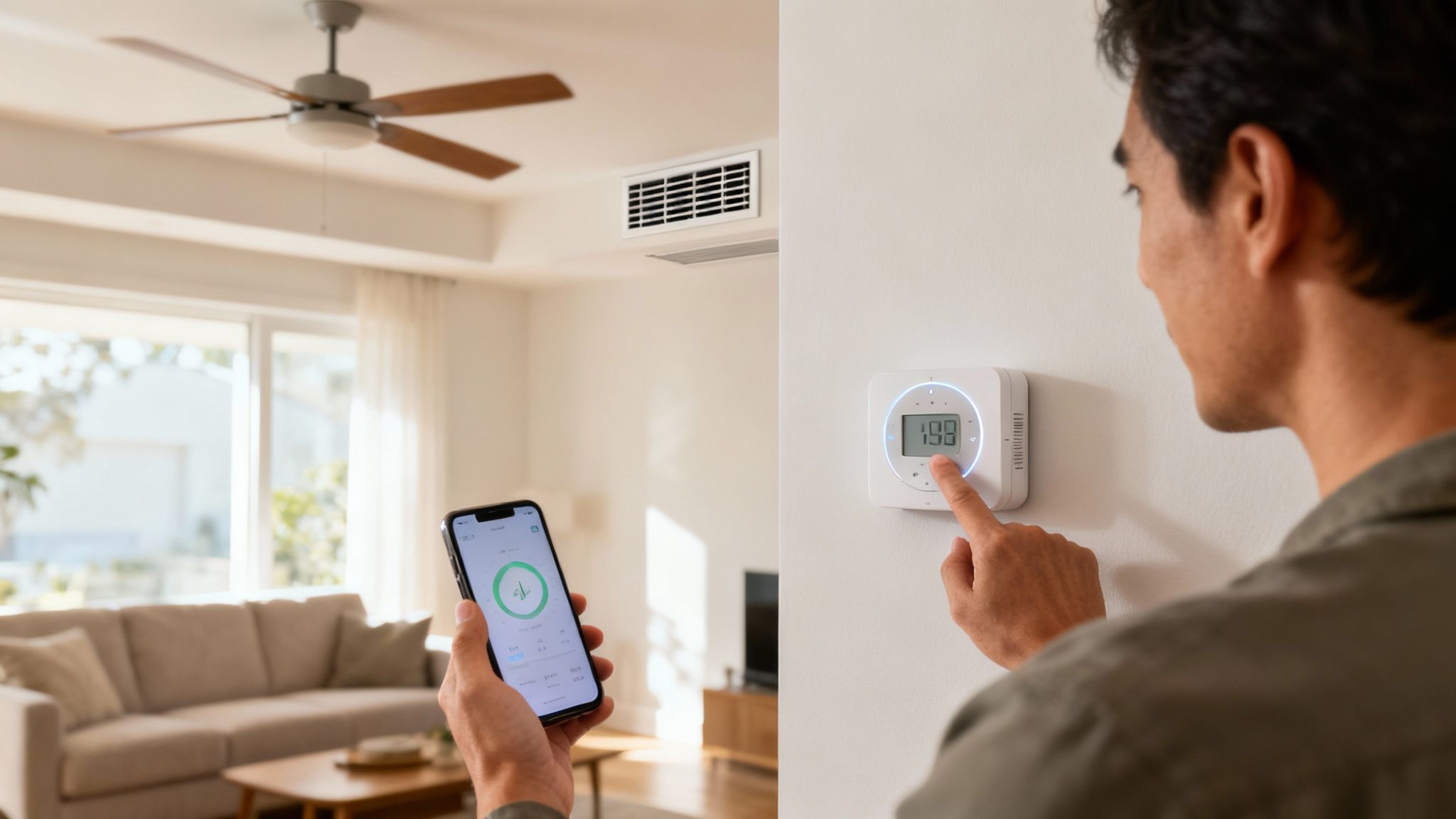
You don't have to sacrifice comfort to master your home's climate. It’s about being smarter, and a programmable or smart thermostat is your best friend in this mission. Instead of fiddling with the dial all day, you can set it and forget it.
Master Your Thermostat and HVAC System
The logic is simple: there’s no reason to blast the heat or AC in an empty house. Just by setting your thermostat back 7°-10°F for eight hours a day—like when you’re at work or asleep—you can slash your heating and cooling costs by as much as 10% a year.
A smart thermostat makes this even easier. These devices learn your family's patterns, adjust automatically when you leave, and let you take control from your smartphone. That level of precision means you're never paying to heat or cool an empty room again.
But technology is only half the battle. Your HVAC system needs basic care to run efficiently. A clogged air filter forces the whole system to work overtime, driving up your energy use and putting unnecessary strain on the equipment. Swapping it out every 1-3 months is one of the simplest, most effective things you can do.
Think of your HVAC system like a car engine. Neglecting basic maintenance is like driving with underinflated tires—you’ll get where you’re going, but you’ll burn way more fuel doing it.
And don't forget about your ceiling fans. In the summer, run them counter-clockwise to create a cool downdraft. This simple trick lets you raise the thermostat by about 4°F without breaking a sweat. In winter, switch the fan to run clockwise; this pulls cool air up and pushes the warm air trapped near the ceiling back down where you can feel it.
Time Your Appliance Usage Strategically
Right behind your HVAC system, the biggest energy hogs are your major appliances: the dishwasher, washing machine, and dryer. When and how you use them can make a surprising difference in your electricity bill, especially if your utility company has a time-of-use (TOU) rate plan.
TOU plans charge more for electricity during "peak hours"—usually late afternoons and early evenings when everyone gets home and demand skyrockets. The cheapest rates are found during "off-peak hours," typically late at night and in the early morning.
Give your local provider a call (like Duke Energy here in the Upstate) and ask if they offer a TOU plan. If they do, shifting a few chores can pay off immediately.
- Dishwasher: Make it a rule to only run it when it's completely full. Better yet, schedule it to start late at night, long after peak hours are over.
- Laundry: Wash your clothes in cold water whenever you can. A staggering 90% of the energy a washing machine uses is just for heating the water. Try to save laundry for weekends or late evenings.
- Dryer: This is a big one. Clean the lint filter after every single load. A clean filter ensures proper airflow and dramatically improves efficiency. When the weather’s nice, use a clothesline or drying rack to skip the energy use entirely.
These adjustments might feel small, but their cumulative impact is anything but. It’s all about shifting from passive energy consumption to active, smart management.
Seal and Secure Against Phantom Leaks
Finally, get into the habit of hunting down small air leaks and drafts. Those tiny cracks around your windows and doors can add up, creating the equivalent of leaving a window wide open all year long. While a major overhaul might require a pro, you can make a huge dent with a trip to the hardware store.
A little caulk and weatherstripping go a long way in sealing those gaps and keeping your conditioned air right where it belongs. For a complete walkthrough, our guide on how to winterize windows and doors breaks down the process with easy, step-by-step instructions.
When you combine these mindful habits, you create a powerful, cost-saving synergy. You lighten the load on your HVAC, use your appliances smarter, and plug the invisible leaks that quietly drain your bank account. To explore more ways to boost your home's performance, check out these general energy efficiency strategies. By building these practices into your daily life, you take back control of your spending and pave the way for a truly efficient home.
Upgrading Windows for Lasting Energy Efficiency
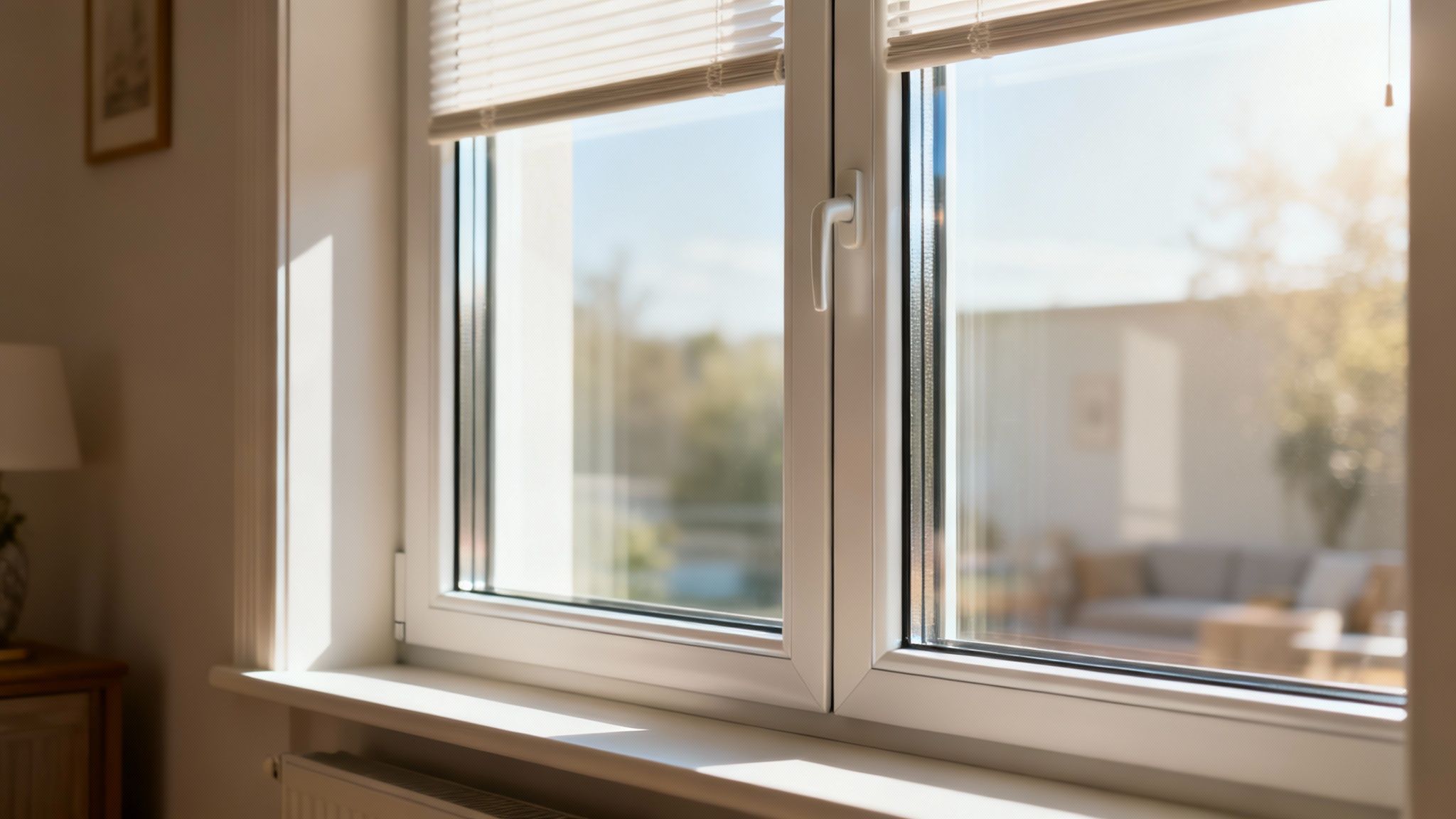
While smart habits can make an immediate dent in your expenses, the real long-term savings come from securing your home’s building envelope. When it comes to weak points, old and inefficient windows are often the biggest culprits. They're like invisible open doors, letting your heating and cooling escape year-round.
Think of single-pane or older double-pane windows as thermal holes. During a sweltering South Carolina summer, they let solar heat pour in, forcing your AC to work overtime. Come winter, they allow the precious warmth from your furnace to radiate right outside. This constant energy leak is a major reason HVAC systems run nonstop, driving up utility bills.
Modern, energy-efficient windows are engineered to solve this exact problem. They create a powerful thermal barrier that keeps your indoor climate stable and comfortable, drastically reducing the load on your HVAC system.
Decoding Modern Window Technology
When you start looking at window replacements, you'll hear a few key terms tossed around. These aren't just marketing buzzwords; they represent significant advancements in building science that directly impact your energy savings. Understanding them is the key to making a smart investment.
- Double-Pane or Triple-Pane Glass: This is the foundation. Instead of one sheet of glass, you have two or three panes separated by a sealed air gap. That gap acts as an insulator, dramatically slowing down heat transfer.
- Low-E Coatings: "Low-E" stands for low-emissivity. It’s an ultra-thin, transparent metallic coating on the glass that reflects infrared light (heat) while letting visible light pass through. It keeps your home cooler in the summer and warmer in the winter.
- Inert Gas Fills: The space between the glass panes is often filled with a dense, non-toxic gas like Argon or Krypton. These gases are heavier than air and provide much better insulation than a simple air gap, further stopping heat in its tracks.
It's also worth remembering that even the best window will fail if it's not installed correctly. A quality installation is just as important as the window itself, preventing drafts and moisture issues that would otherwise undermine your entire investment.
The Real-World Impact on Your Wallet
The benefits here aren't just theoretical—they translate into real, year-round savings. In a climate like Upstate South Carolina, with its hot, humid summers and surprisingly chilly winters, the impact is even more dramatic. High-performance windows help maintain a consistent indoor temperature, so your HVAC system cycles on less frequently and for shorter periods.
This is a huge deal. According to the U.S. Department of Energy, windows can be responsible for about 30% of a home's heating and cooling energy use. Swapping old single-pane models for modern, certified units can slash that energy loss by up to 40-50%.
For most homeowners, that translates to annual savings of $200-$500 on utility bills. It's a significant return on investment that also makes your home more comfortable and valuable.
Key Takeaway: Upgrading to energy-efficient windows isn't just an expense; it's a long-term investment in reducing your monthly overhead. The immediate comfort improvement is matched by a steady financial return that continues for the life of the windows.
Knowing When It’s Time for an Upgrade
So, how can you tell if your current windows are silently draining your bank account? There are several telltale signs that your windows are no longer doing their job and are likely contributing to high energy costs. If you spot any of these, window replacement should be high on your priority list.
Common Signs of Failing Windows:
| Visible Drafts | Feeling a chill near the window in winter? That means heated air is escaping, and your furnace is working harder to compensate. |
| Condensation Between Panes | Fog or moisture trapped between the glass panes means the seal has failed. The insulating gas is gone, and so is the window's efficiency. |
| Difficulty Opening/Closing | Warped or damaged frames don't just cause operational headaches; they prevent a proper seal, leading to constant air leakage. |
| Single-Pane Glass | If your home still has single-pane windows, you are guaranteed to be losing a massive amount of energy. This is the least efficient window type possible. |
Upgrading to Energy Star windows is one of the most powerful moves you can make to permanently lower your utility costs while boosting your home's comfort and value.
How High-Performance Siding Slashes Your Energy Bills
Think of your home's siding as more than just curb appeal—it’s the protective skin of your entire house. While its main job is to fend off rain, wind, and pests, one of its most critical—and often overlooked—roles is managing how your home handles energy.
If your siding is old, cracked, or poorly insulated, you're fighting a losing battle. It’s a major weak point where the conditioned air you’re paying to heat or cool constantly leaks out, while the brutal summer heat or winter cold seeps in. This invisible exchange forces your HVAC system to work overtime, day in and day out, just to keep you comfortable.
Upgrading to high-performance siding is one of the single most effective ways to lower your utility bills because it fundamentally changes this dynamic. It’s like wrapping your home in a high-tech thermal blanket, creating a continuous barrier against the elements.
Modern materials like insulated vinyl and fiber cement are engineered to do so much more than just look good. They’re designed from the ground up to boost your home’s thermal resistance, giving you a more stable, comfortable, and efficient living space.
The Real-World Impact of Siding and R-Value
You’ve probably heard of R-value—it’s simply a measure of how well an material resists heat flow. The higher the R-value, the better the insulation.
Here’s the problem with most homes: the wall studs create a direct path for heat to travel right through your walls. It's a phenomenon called thermal bridging, and standard siding does next to nothing to stop it.
This is where high-performance siding systems really shine. When you choose an option with integrated rigid foam insulation, you’re adding a significant layer of R-value across your entire wall. This new layer covers the wall studs, effectively breaking that thermal bridge and dramatically slowing down heat transfer.
This isn’t just theory; it’s a proven strategy for cutting utility costs. In fact, installing fiber cement or vinyl siding with advanced insulation backs can boost your wall’s total R-value by 30-50%. For most homeowners, that translates into a 10-25% reduction in annual energy bills. The International Energy Agency's recent Energy Efficiency report points to these exact kinds of building envelope upgrades as a key driver of improving residential energy efficiency worldwide. You can discover insights on energy efficiency advancements and see how these trends are taking shape globally.
Bottom line? A well-insulated home holds its temperature for much longer. Your HVAC system runs less often, uses less energy, and suffers less wear and tear, saving you money on monthly bills and long-term maintenance.
Choosing the Right Siding for the Upstate Climate
Here in Upstate South Carolina, our homes face a unique set of challenges: intense summer heat, stifling humidity, and the occasional severe storm. Your siding needs to be tough enough to handle it all.
Two materials consistently stand out for both their durability and energy performance in our climate.
- Insulated Vinyl Siding: This is a fantastic, cost-effective option. The siding panels come backed with a form-fitted layer of expanded polystyrene (EPS) foam, which adds a serious layer of insulation. It's also incredibly low-maintenance—it never needs painting and easily resists moisture and pests.
- Fiber Cement Siding: Known for its incredible toughness, fiber cement is practically bulletproof. It resists fire, rot, insects, and the impacts from hail or wind-blown debris. When you pair it with a high-quality house wrap and insulation, you get an exceptionally resilient and energy-efficient barrier. Plus, it holds paint beautifully and can give you the classic look of wood without any of the maintenance headaches.
Both of these options create a robust shield against the elements, preventing moisture from getting in where it can damage your home’s structure and ruin your insulation’s effectiveness. You can dive deeper into the benefits of fiber cement siding in our detailed guide to see if it’s the right choice for your home.
A siding upgrade is an investment in your home's performance and its curb appeal. It’s one of the few home improvement projects that actually pays you back through lower energy bills, reduced maintenance, and a significant boost in property value.
Thinking Long-Term: More Than Just Energy Savings
While the immediate drop in your utility bills is a huge win, the financial perks of new siding go much further. Old, failing siding is a gateway to expensive problems, from hidden water damage and mold growth to destructive pest infestations.
By installing a modern, high-performance siding system, you aren't just improving energy efficiency—you're protecting your home's structural integrity for the long haul. It's a proactive investment that helps you avoid thousands in costly repairs down the road.
The sheer durability of materials like fiber cement and insulated vinyl also means you’ll reclaim your weekends. Forget about scraping, sanding, and repainting every few years. This long-lasting, low-maintenance performance adds up to real savings over the life of your home, making it a cornerstone of a smart, secure, and energy-efficient future.
Why Effective Gutters Are Your First Line of Defense
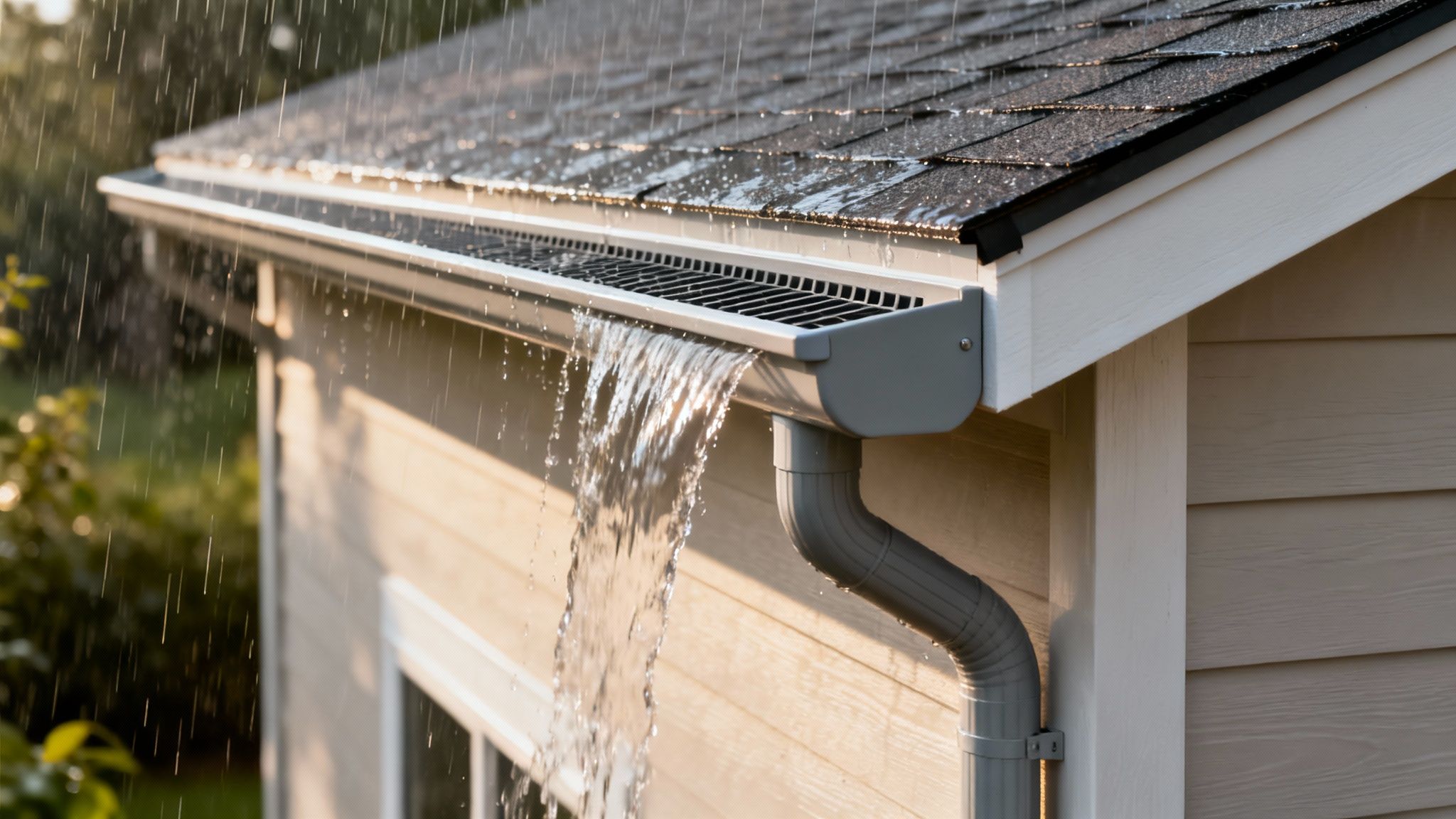
It’s easy to write off gutters as a simple trough for catching rain. But these overlooked channels are one of the most critical parts of your home's energy puzzle. A failing gutter system can quietly become a massive, hidden driver of high utility bills, creating expensive problems long before you ever see them.
When gutters get clogged with leaves, twigs, and other gunk, they simply stop working. Rainwater has nowhere to go but over the edge, cascading down your siding and pooling right at your foundation. That runaway water doesn't just stain your exterior—it soaks into the very structure of your home, saturating the insulation in your walls and attic.
The Hidden Connection Between Water Damage and Energy Waste
Here’s the thing about insulation: it only works when it’s dry. Its job is to trap pockets of air to resist heat transfer. When that insulation gets wet, water fills those air pockets, and its insulating power plummets. Damp insulation is almost as bad as having no insulation at all.
So, what does that mean for your wallet? In the summer, heat sails right through those waterlogged walls, forcing your AC to run nonstop. In the winter, the expensive heat your furnace is generating escapes just as easily. The result is a home that’s always a battle to keep comfortable and far more expensive to run.
This isn't a small problem. We see it all the time—homes with poor gutters suffer from chronically damp walls and attics, which can slash insulation effectiveness by up to 50%. This forces HVAC systems to burn 20-30% more energy just to keep up. For homeowners in storm-heavy areas like Greer and Simpsonville, that's a huge deal. In fact, you can explore EIA data on home efficiency losses that shows homes in the Southeast can waste over $400 a year from efficiency drops caused by water damage alone.
Preventing a Cascade of Costly Problems
The damage from overflowing gutters goes way beyond wasted energy. That constant moisture is a perfect breeding ground for mold and mildew, which can tank your home’s air quality and lead to expensive remediation. It also causes wood rot in your home’s framing, soffit, and fascia, turning a simple gutter problem into a major structural repair nightmare.
By the time you spot peeling paint on an interior wall or notice a musty smell, the damage is already well underway. This is why being proactive is so much smarter—and cheaper—than reacting to repairs.
Investing in a high-quality gutter system is one of the most effective preventative measures a homeowner can take. It’s not just about managing rainwater; it’s about protecting the entire building envelope from moisture that degrades performance and drives up costs.
Why Seamless Gutters Are the Superior Solution
The best fix is to upgrade to a system that’s built for performance and minimal maintenance. This is where seamless gutters really shine. Unlike traditional sectional gutters, which are pieced together with seams every 10 feet, seamless gutters are custom-made on-site to fit your home’s exact measurements.
This single-piece design offers some huge advantages:
- Fewer Leaks: No seams along the straight runs means far fewer weak spots where leaks can start. This drastically reduces the risk of water getting behind the gutter and damaging your walls.
- Reduced Debris Buildup: The smooth, continuous channel is less likely to snag leaves and twigs, which helps stop clogs from forming in the first place.
- Enhanced Durability: Seamless systems are just plain stronger and more resilient, standing up better to the heavy downpours and storms we get in our region.
When you pair a seamless system with modern, clog-resistant guards, you get a powerful, low-maintenance defense. These guards keep debris out while letting water flow freely, making sure your home is protected year-round. You can learn more about the specific advantages by comparing seamless gutters vs. regular gutters in our detailed analysis.
Ultimately, this proactive investment doesn’t just preserve your home's energy performance—it prevents a whole host of expensive moisture-related repairs down the line.
A Few Common Questions We Hear
Making the decision to invest in your home's energy performance is a big one, and it’s completely normal to have a few questions before you start. Getting clear, honest answers is the best way to feel confident about the project and make sure you're putting your money where it counts.
Let's cut through the jargon and tackle some of the most common questions homeowners have when they're planning these kinds of upgrades.
Which Upgrade Offers the Best ROI?
This is the big one, and while the perfect answer depends on your home’s specific weak spots, replacing old windows with Energy Star-certified models often delivers the biggest bang for your buck. It’s not uncommon for windows to be responsible for up to 30% of a home's heating and cooling loss. Swapping them out plugs those huge thermal holes, giving you immediate, year-round savings.
But here’s a pro tip: a holistic approach is always best. If you have old, drafty siding, pairing a window replacement with new siding creates a powerful one-two punch. You’re essentially wrapping your home in a brand-new thermal envelope for maximum efficiency.
How Can I Spot Failing Windows and Siding?
You don't have to be an expert to know if your home's exterior is costing you money. There are some tell-tale signs that your siding or windows are past their prime and driving up your energy bills.
For your windows, keep an eye out for:
- Obvious drafts or a noticeable chill when you stand near them on a cold day.
- Condensation or fog trapped between the glass panes—a dead giveaway that the seal has failed.
- Frames that are warped or soft, making the windows a pain to open and close.
With siding, the red flags are just as clear:
- Cracked, warped, or missing panels that leave the protective underlayment exposed.
- Peeling paint or rotting wood on your home's exterior, often a sign that moisture is getting in.
- A sudden, unexplained spike in your heating or cooling bills that you can't trace to anything else.
If you’re nodding along to any of these, your home is almost certainly leaking energy. A quick inspection from a local contractor can pinpoint the source and give you a clear plan of action.
Are There Any Tax Credits Available for These Upgrades?
Absolutely. Homeowners can often take advantage of federal programs designed to help offset the cost of energy-efficient upgrades. These incentives are there to encourage improvements that reduce overall energy consumption, making projects like new windows and insulation much more affordable.
On top of that, some local utility providers here in South Carolina occasionally offer their own rebates for specific projects. These programs can change from year to year, so it's always smart to ask your contractor. They’re usually dialed into the latest credits and can help you navigate the paperwork.
For a deeper dive, you can learn more about the Energy Star windows tax credit and see if your project qualifies.
Ready to transform your home's efficiency and finally take control of your utility bills? The expert team at Atomic Exteriors specializes in high-performance siding, window, and gutter solutions designed for the Upstate climate. Get your free, no-obligation estimate today and start planning a smarter, more comfortable future for your home. Learn more at https://atomicexteriors.com.