.png)
Siding installation cost calculator: Plan Your Upstate SC Project Costs
Thinking about giving your home a fresh new look? A siding installation cost calculator is the perfect place to start. It’s a simple online tool that gives you an instant, ballpark estimate for your project before you even pick up the phone. Think of it as your first step in mapping out the budget.
Why a Siding Cost Calculator Is Your Best First Step
Taking on a siding replacement project can feel like a huge undertaking, especially when you start thinking about the cost. Is that beautiful new exterior you've been dreaming of actually within reach? A siding cost calculator cuts right through that uncertainty, turning a vague idea into a tangible financial range. It's like a financial compass, pointing you in the right direction.
The tool isn't running on magic—it just uses a few key details you provide to crunch the numbers. The main things it needs are your home’s size, the siding material you're considering, and the general complexity of the job. Once you plug that in, you get a baseline figure that lets you plan with confidence.
Setting Realistic Expectations
The biggest win here is setting realistic expectations right from the get-go. The calculator demystifies the costs and shows you what really drives the final price. For homeowners in Greenville and Anderson, this initial homework is crucial for making smart decisions down the road.
For instance, you can quickly see the price difference between premium fiber cement siding versus a more budget-friendly vinyl. This lets you weigh your aesthetic goals against your financial comfort zone from day one. You can learn more about our different siding options to see what might work for your home.
A siding calculator is your "what-if" machine. It lets you explore different material and design choices without any commitment, giving you a safe and easy way to start your research and build a foundational budget.
The Bridge to a Professional Quote
Now, while a calculator is incredibly helpful, its estimate is just that—an estimate. It can't see the unique quirks of your home, like tricky architectural angles, the condition of the walls underneath, or specific building codes here in Upstate SC.
That's why the calculator is the perfect bridge to the next, most important step: getting a professional, in-person quote. Your initial numbers give you a solid starting point for a meaningful conversation with an expert. When a pro from Atomic Exteriors comes to your home, they build on your research, inspecting for hidden issues and accounting for every last detail to give you a precise, reliable, and transparent quote for the entire project.
Getting a Real-World Siding Estimate with an Online Calculator
Think of an online siding calculator as a GPS for your budget. If you punch in a vague destination, you’ll get a fuzzy route. But if you give it precise coordinates, it'll give you a remarkably accurate idea of the journey ahead. The numbers you put in directly shape the estimate you get out—garbage in, garbage out.
To get a truly useful ballpark figure, you’ll need to do a little homework first. A few minutes of measuring and thinking about your project will make the difference between a wild guess and a solid financial starting point.
First Things First: Measure Your Home’s Exterior
This is the number one spot where people go wrong. Your home's exterior wall area is not the same as its interior square footage. You need the total surface area that will actually get new siding.
Here’s a straightforward way to get a solid number:
Grab a Tape Measure: Go outside and measure the length and height of each exterior wall.
Do the Math: Multiply the length by the height for each wall to get its area in square feet.
Add It All Up: Combine the totals for every wall. Don't forget dormers! They add more surface area than you’d think.
For tricky triangular spots like gables, just measure the base and the height, multiply them, and then divide by two (Area = 0.5 x Base x Height). Getting this initial measurement right is the most critical step.
Choosing Your Siding Material
The type of siding you pick is easily the biggest lever on the total cost. A good calculator will let you toggle between options like vinyl and fiber cement, and you’ll immediately see how your choice impacts the bottom line.
- Vinyl Siding: This is the go-to for many homeowners because it’s cost-effective, easy to clean, and comes in a ton of colors. It's a fantastic way to give your home a fresh look without breaking the bank.
- Fiber Cement Siding: Think of this as the premium, long-term investment. It's incredibly durable, resistant to pests and fire, and gives your home a high-end look that can seriously boost its value.
Play around with both options in the calculator. Seeing the price difference in black and white is the best way to understand where your money is going.
Don't Forget Doors, Windows, and Awkward Angles
You're not putting siding over your doors and windows, so you need to subtract their area from your total. Measure the height and width of each one, calculate the square footage, and subtract that total from your home’s overall exterior surface area. This gives you a much more accurate material estimate.
Now, think about your home's shape. A simple, one-story rectangular house is a breeze to side. A two-story home with lots of gables, dormers, and funky angles? That’s a whole different ballgame. All those extra cuts and details take time and skill, which adds to the labor cost.
Most calculators won't have a "complexity" slider, but this is crucial context. If your home has a lot of architectural details, you should expect the real-world quote to be higher than a basic online estimate.
Remember, the calculator's job is to give you a strong baseline. The more accurate your inputs are, the more that online number will reflect the reality of your project's potential cost.
This kind of detailed planning is helpful for any big exterior project. In fact, if you're also considering new windows, our guide on how to use a window replacement cost estimator uses the very same principles to help you nail down a reliable budget.
By taking a few minutes to gather these key "ingredients"—your home's true exterior square footage, your material preference, and an honest look at its complexity—you’ll get a calculator estimate you can actually trust. It makes the next step—getting a detailed, in-person quote—a much smoother and more productive conversation.
Comparing Siding Materials: Vinyl vs. Fiber Cement
When you plug numbers into a siding cost calculator, you’ll notice one choice makes the biggest difference: the material itself. It’s a lot like buying a car—the base model gets you where you need to go, but the premium trim level comes with a whole different feel and performance. For homeowners here in Upstate South Carolina, that choice usually boils down to two fantastic options: classic vinyl or ultra-durable fiber cement.
Each one has its own personality, and the right fit depends entirely on your goals. We're not just talking about the initial price tag, but also long-term value, how much maintenance you’re willing to do, and how well your home will stand up to our humid summers and surprise storms. Getting this right is the first step to a project you’ll love for decades.
The Case for Vinyl Siding: A Smart and Stylish Choice
Vinyl siding is, without a doubt, the king of affordability and easy living. It’s hands-down one of the most popular choices across Greenville and Anderson, and for good reason. It offers a clean, modern look without the sticker shock, making it a practical way to give your home a major facelift. And since the color is baked right in, you can officially say goodbye to scraping and painting. Forever.
So, why do so many people choose vinyl?
- Cost-Effectiveness: It’s typically the most budget-friendly siding out there, letting you transform your home's curb appeal for a lower upfront investment.
- Minimal Maintenance: Forget constant upkeep. A quick wash with soap and water once a year is usually all it takes to keep vinyl looking brand new. It naturally resists pests and won’t rot or warp in our southern humidity.
- Energy Efficiency: When you pair it with a quality insulation underlayment, insulated vinyl siding creates a thermal blanket around your home, helping you fight the South Carolina heat and potentially lowering your energy bills.
This diagram shows the key ingredients that go into a siding estimate, with material being a huge piece of the puzzle.
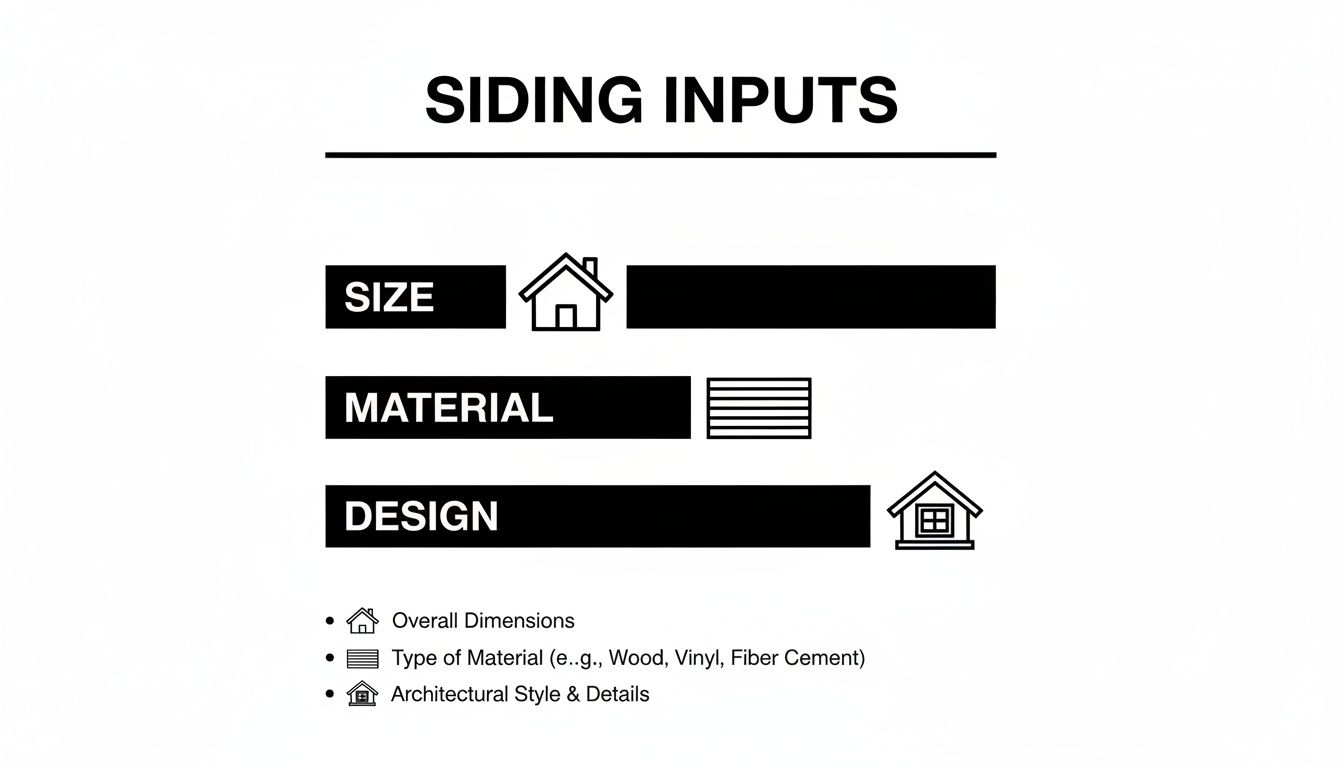
As you can see, the size of your home, its design, and the siding you pick are the foundational blocks that build the final cost of your project.
The Power of Fiber Cement: A Premium and Protective Investment
If vinyl is the reliable family sedan, fiber cement is the rugged, high-performance SUV built for anything. Made from a tough-as-nails blend of cement, sand, and cellulose fibers, this stuff is engineered for one thing: to last. For homeowners who put storm resistance and a high-end look at the top of their list, fiber cement is tough to beat.
Here’s where it really shines:
- Unmatched Durability: It’s resistant to just about everything—fire, rot, termites, and the kind of impact from hail or stray baseballs that would dent lesser materials.
- Authentic Look: Fiber cement can beautifully mimic the look of natural wood grain, stone, or stucco, giving you that premium curb appeal that can seriously boost your home’s resale value.
- Weather Resistance: It laughs at the intense sun, humidity, and pop-up storms we get around here. It simply won't warp or break down.
While fiber cement costs more upfront, its incredible longevity and resilience often mean you spend less over the decades. It's a true long-term investment in protecting your home.
Let’s talk numbers. Data shows that for a typical 2,500 sq ft house, vinyl siding installation might range from $13,325 to $24,300. Fiber cement, on the other hand, often runs between $7 to $18 per square foot installed, reflecting its premium build. An online calculator is a great first step to see how these numbers play out for your specific home.
To get a better handle on this, our detailed guide on fiber cement siding vs vinyl cost breaks it all down even further.
Making smart material choices is a theme in any home renovation. Whether it's siding or a new driveway, weighing the pros and cons is key. For a wider perspective, you can explore a relevant material comparison for home improvements that highlights similar decision-making processes. Ultimately, the best siding for you comes down to balancing what you spend today with the performance you expect tomorrow.
Of course. Here is the rewritten section, crafted to sound like it was written by an experienced human expert.
How Your Home's Size and Design Affect the Final Price
It’s easy to assume that the square footage of your house is the only number that really matters when you're punching details into a siding cost calculator. And while it's definitely the biggest piece of the puzzle, it's far from the whole story. Your home’s unique character—its shape, height, and all those little architectural details—plays a huge role in the final price tag.
Think of it like this: you could have two homes with the exact same interior living space, but one could cost thousands more to re-side. A simple, single-story ranch house is mostly long, straight runs. Easy peasy. But a two-story home with multiple gables, dormers, and bump-outs? That's a completely different ballgame, demanding way more time, skill, and material.
More Than Just Square Footage
The foundation of any siding quote is, naturally, the total exterior surface area. More walls mean more material and more labor. But where the cost really starts to get interesting is in the complexity of that surface area.
- Architectural Features: Every single corner, window, and roofline needs a precise cut and careful sealing. Gables, dormers, and intricate trim work are beautiful, but they dramatically increase the hours our crew spends on your home.
- Number of Stories: Siding a second or third story isn't as simple as siding the first. It requires extra equipment like scaffolding and ladders, which adds setup time and introduces safety protocols that are factored into the labor cost.
- Material Waste: The more complex the design, the more angled cuts we have to make. This inevitably leads to more leftover material (waste) compared to siding a simple, flat rectangular wall.
This is exactly why your neighbor with a 2,500-square-foot home might get a completely different quote than you, even if your house is the same size on paper. Their home's design could be far simpler—or far more complex—than yours.
Putting Numbers to Different Home Sizes
To give you a real-world sense of scale, it helps to look at some typical cost ranges. For homeowners here in the busy markets of Upstate South Carolina, knowing these figures is key for smart budgeting. Nationally, a 1,500 sq ft home using standard materials like vinyl could cost anywhere from $1,500 to $20,250. A larger 2,500 sq ft property might range from $2,500 to $33,750. Those huge ranges show just how much material choice and project complexity can swing the final price. You can dive deeper into siding replacement costs to understand all the variables.
Keep in mind, these are broad ranges. A siding installation cost calculator gets you into the right ballpark, but only an on-site inspection can truly account for the unique architectural DNA of your home.
This table gives a clearer picture of how size and complexity can impact a siding project's budget.
| Simple 1-Story Ranch | 1,500 sq ft | Low | $7,500 - $13,500 |
| Standard 2-Story Colonial | 2,500 sq ft | Medium | $12,500 - $22,500 |
| Complex 2-Story with Dormers | 2,500 sq ft | High | $16,000 - $27,000+ |
As you can see, that colonial with dormers costs significantly more than the standard colonial—even at the exact same square footage. Those extra details demand specialized labor and more intricate work, which naturally drives the price up.
At the end of the day, your home’s size provides the foundation for the estimate, but its design is what fills in all the critical details. This is why a professional, in-person assessment is so valuable. It moves beyond the basic numbers to capture the true scope of work, ensuring your final quote is both accurate and fair.
From Online Estimate to Professional On-Site Quote
A siding installation cost calculator is a fantastic tool. It gives you an excellent starting point, turning a fuzzy idea about cost into a real, workable budget. But it’s important to remember that this online number is the beginning of the conversation, not the final word. The real path to a firm, reliable price tag starts when a professional steps onto your property.
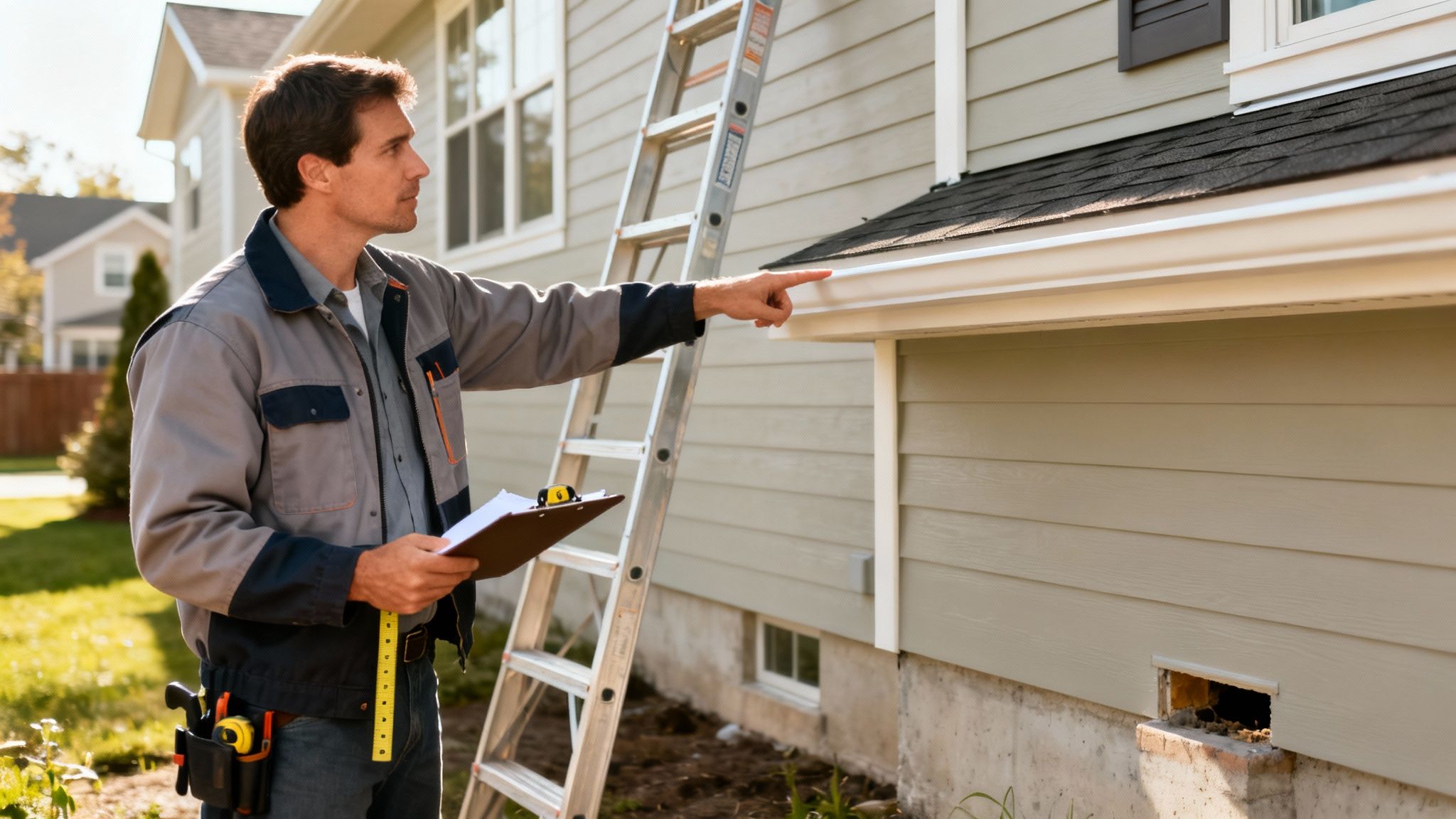
Think of the calculator's estimate as a map and our on-site quote as the actual journey. A map shows you the main roads, but it can’t warn you about unexpected detours or a bridge that’s out. That’s what an expert from Atomic Exteriors does during a free, in-person assessment—we see what a calculator simply can’t.
What an Expert Looks for On-Site
When we visit your home, we do a lot more than just double-check your measurements. Our team conducts a thorough inspection to uncover the hidden variables that directly impact the scope and cost of your project. This detailed assessment is what allows us to give you a transparent, all-inclusive quote.
Our inspection process includes:
- Searching for Hidden Damage: We carefully check for signs of wood rot, moisture damage, or pest infestations hiding beneath your current siding. These issues must be fixed before new siding goes on to protect your home’s structure.
- Assessing the Underlayment: The condition of the sheathing—the layer of board under the siding—is critical. We make sure it's a solid, stable surface for the new installation.
- Checking Local Building Codes: We verify that your project will comply with all specific building codes in Greenville, Spartanburg, or Anderson, including any requirements for insulation and weather barriers.
This professional assessment isn’t about finding problems; it’s about providing solutions. Discovering these factors upfront prevents costly surprises halfway through the project and guarantees a high-quality, long-lasting result. It also helps you explore all your options, a key step when choosing materials. For more on that, see our insights on selecting from local siding contractors near me.
The Value of a Professional Quote
An on-site quote from Atomic Exteriors is more than just a number—it’s a detailed plan built on transparency and trust. It outlines every aspect of the job, ensuring there are no hidden fees or unexpected charges down the road.
An on-site quote transforms a budget estimate into a project guarantee. It accounts for your home’s unique needs and provides a clear, fixed price backed by a solid workmanship warranty.
The siding industry is a massive part of the global economy. The worldwide market was valued at USD 125.8 billion last year and is projected to hit USD 203.9 billion within a decade. That growth shows just how much homeowners value durable, energy-efficient exteriors. For homeowners here in Upstate SC, a smart siding project not only protects your home from the weather but also taps into market trends that boost its value. As you move from an online estimate to getting professional quotes, you might find it interesting to see how related businesses market themselves, like these effective advertising strategies for home service companies.
Common Questions About Siding Installation Costs
It's natural to have a few questions after using a siding calculator and starting to picture what a new exterior could look like. Getting straightforward answers is the best way to feel confident about your investment.
We get these questions all the time from homeowners across Upstate South Carolina. Here’s a quick rundown of what you need to know before taking the next step.
How Accurate Is an Online Siding Calculator?
An online calculator is a fantastic starting point. It's designed to give you a solid ballpark figure for budgeting, helping you compare different material costs and get a feel for the overall financial picture.
But at the end of the day, it's an algorithm—it can't see the unique details of your home. It won't spot hidden rot behind an old wall, account for tricky architectural features, or know the specific permit fees in your town. Think of the online estimate as a well-informed first guess. For a firm, lock-it-in price, nothing beats having a professional see the property in person.
Does Replacing Siding Increase My Home's Value?
Absolutely. New siding is consistently ranked as one of the smartest exterior remodeling projects you can do. It delivers a massive boost to curb appeal and almost always provides a strong return on your investment when it's time to sell.
A fresh, modern exterior doesn't just look great; it also signals to potential buyers that the home is well-maintained. High-quality materials also improve energy efficiency, which is a huge selling point for anyone in our region. If you're weighing your options, learning more about the fiber cement siding pros and cons can help you decide which material offers the best long-term value for your home.
What Does a Siding Installation Quote Include?
A good quote leaves no stone unturned. It should be completely transparent, with every cost broken down so there are zero surprises later on.
A professional estimate from a reputable company will always include:
- Materials: The cost of the siding panels, all trim, and finishing accessories.
- Labor: The hands-on work from an experienced, professional installation crew.
- Preparation: The safe removal and responsible disposal of all your old siding.
- Protection: The installation of a brand-new, high-quality weather-resistant barrier.
- Cleanup: A complete site cleanup when the job is done—we leave it better than we found it.
Always make sure the quote spells out the workmanship warranty. A trustworthy contractor puts everything in writing so you know exactly what you’re paying for and how your investment is protected.
How Long Does a Typical Installation Take?
This really depends on the size and complexity of your home. For an average-sized house without any major issues, we can typically complete the job in one to two weeks.
Of course, some things can stretch that timeline. Discovering extensive repairs needed on the structure underneath, dealing with intricate architectural details, or getting hit with a week of bad weather can add time. Any professional estimator will give you a clear, projected timeline during your consultation so you know exactly what to expect from start to finish.
Ready to turn your online estimate into an exact quote? The team at Atomic Exteriors is here to provide a free, no-obligation inspection and a transparent proposal for your siding project. https://atomicexteriors.com